



Chrome Extension Sponsorship Deals: How to Land Your First Sponsor
Find sponsors, price CPM deals, and write a pitch that lands your first Chrome extension sponsorship — no huge user base required.

Article content
You built a Chrome extension that real people use every day. Your user count is growing. But your revenue? Still crickets. Here's the good news: chrome extension sponsorship is one of the most underutilized monetization paths for indie makers — and you don't need 100,000 users to land your first deal.
In this guide, you'll learn exactly how to prepare your extension for sponsorship, find the right brands to pitch, and structure a deal that pays you fairly. By the end, you'll have a clear, actionable framework — not just theory.
The Chrome extension market is valued at $2.5 billion in 2025 and is expected to hit $5.0 billion by 2033 (HTF Market Insights, 2025). Meanwhile, Chrome reaches 3.83 billion users globally with a 67.72% browser market share (Backlinko, 2025). Sponsors know this. Your job is to show them why *your* slice of that audience matters.
Why Sponsorship Is a Smart Monetization Strategy for Indie Makers
Most indie developers jump straight to freemium or one-time payments. Both are fine, but they take time — time to build pricing tiers, time to fight churn, time to deal with refund requests. Sponsorship sidesteps all of that.
With a sponsorship deal, you get paid based on your existing audience reach — not on conversion rates or payment infrastructure. A brand pays you a flat fee (or CPM-based rate) to appear in front of your users. You keep full product control, and the brand gets distribution to a niche, high-intent audience.
This model works especially well for extensions that attract a specific professional or hobbyist crowd. A developer tool extension with 5,000 active users is enormously valuable to a SaaS company targeting developers. Niche beats scale when it comes to brand relevance.
Sponsorship also layers cleanly on top of other revenue streams like affiliate marketing or lifetime deals. Edmund Yong's Easy Folders extension hit $3,700 MRR and $42,000 in total revenue within six months of launch (Indie Hackers, 2024). Even a single modest sponsorship deal layered on top of that would add a meaningful income stream without touching the core product. Use our Chrome extension revenue calculator to see how a sponsorship deal stacks against equivalent subscription MRR at your current user count.
How to Prepare Your Chrome Extension for Sponsorship
Before you pitch anyone, your extension needs to look credible. Brands do basic due diligence, and a half-finished store listing will kill a deal faster than a small user count.
Get Your Chrome Web Store Listing in Order
Your listing is your pitch deck. Write a clear, compelling description that explains who the extension is for and what problem it solves. Add quality screenshots and — if you can — a short demo video. The $5 one-time developer registration fee is the only barrier to a professional presence (Chrome Web Store Docs, 2025).
Collect Your Metrics
Sponsors want numbers. Pull your active user count, weekly installs, and — if you have them — retention stats. Even basic data like "2,000 active weekly users, 4.6 stars across 180 reviews" tells a compelling story. Track these numbers consistently so you can show growth trends over time.
Define Your Audience Clearly
Write a one-paragraph audience profile. What job do your users have? What tools do they already use? What problem does your extension solve for them? The more specifically you can describe your audience, the easier it is for a sponsor to see alignment with their product.
Chrome Goldmine can help you benchmark your extension against comparable tools — understanding where you stand in your niche is the first step to pricing your sponsorship correctly.
Finding the Right Sponsors for Your Chrome Extension
This is where most indie makers stall. They think sponsorship means cold-emailing Fortune 500 companies. It doesn't.
Start With Products Your Users Already Pay For
Look at what your audience buys. If your extension is a developer tool, think about SaaS products in that space — API testing tools, documentation platforms, code review services. These companies have marketing budgets and they actively look for niche developer audiences to reach.
Where to Find Potential Sponsors
SaaS affiliate and partnership pages are a goldmine. Most mid-sized SaaS companies list partnership or affiliate opportunities on their website. Start there — if they have an affiliate program, they have a budget for audience-building. Browse our recommended tools and platforms for partnership inspiration.
Indie Hackers and Product Hunt are also useful. Look at what tools get upvoted by the same audience your extension serves. The makers behind those tools are often open to sponsorships — especially if they're fellow indie makers who understand the model.
Your own install base is the most underrated source. Look at who is using your extension. If enterprise users from specific companies keep showing up in your feedback or reviews, reach out to those companies directly.
What Brands Are Looking For
Sponsors want three things: audience fit, transparent metrics, and a clear deliverable. They want to know your users look like their customers, they want to see real numbers (not just installs), and they want to understand exactly what they're getting — a banner in your popup, a mention in your onboarding flow, or a dedicated placement in your new tab override. Building an email list with MailerLite is one of the best ways to demonstrate audience engagement to potential sponsors — subscriber count and open rates are concrete proof that your users are active and reachable.
Crafting a Sponsorship Pitch That Gets Noticed
A bad pitch is the most common reason sponsorship deals die before they start. Most indie makers either undersell their extension or write an essay that never gets read.
Keep It Short and Specific
Your initial outreach should be no longer than five sentences. State who you are, what your extension does, who uses it, why their product is a good fit for your audience, and what you're proposing. That's it. You're not closing the deal in the first email — you're opening a conversation.
What to Include in Your Pitch Deck
If they respond and ask for more, have a one-page sponsorship deck ready. Use Canva to create a professional, branded deck quickly — it makes a strong first impression without needing design skills. It should include:
- Extension name and description (one sentence)
- Active user count and growth trend
- Audience profile (who uses it and why)
- Available placements (where the sponsor would appear)
- Pricing options (see the pricing section below)
- Testimonials or reviews from your user base (optional but powerful)
Follow Up — Once
If you don't hear back within a week, send one follow-up. Keep it brief: "Just checking if this landed — happy to share more data if useful." After that, move on. Chasing uninterested brands wastes time you could spend pitching better-fit sponsors.
Common Mistakes to Avoid When Seeking Sponsorships
Getting sponsorship wrong doesn't just lose you money — it can damage your reputation with brands and make future deals harder to land.
Pitching brands with no audience fit. Sending a generic pitch to twenty companies that have nothing to do with your users is a waste of everyone's time. If the brand would never advertise in a trade publication your users read, don't pitch them.
Undervaluing your reach. Many indie makers feel embarrassed about their user count and discount their rates before anyone asks them to. Don't. A highly engaged niche audience of 3,000 users is worth more to the right brand than a disengaged mass audience of 50,000.
Skipping the contract. Verbal agreements and handshake deals lead to scope creep, late payments, and disputes over deliverables. Always confirm the deal in writing — even a simple email outlining the terms works better than nothing.
Overselling and underdelivering. If you promise 5,000 impressions and your extension only shows the placement to 800 active users that month, you'll lose trust immediately. Be conservative with your estimates and transparent about your methodology.
How Much Should You Charge for a Chrome Extension Sponsorship?
Pricing is the question every indie maker dreads — and most get wrong by going too low. Here's a practical framework based on active users and industry CPM benchmarks.
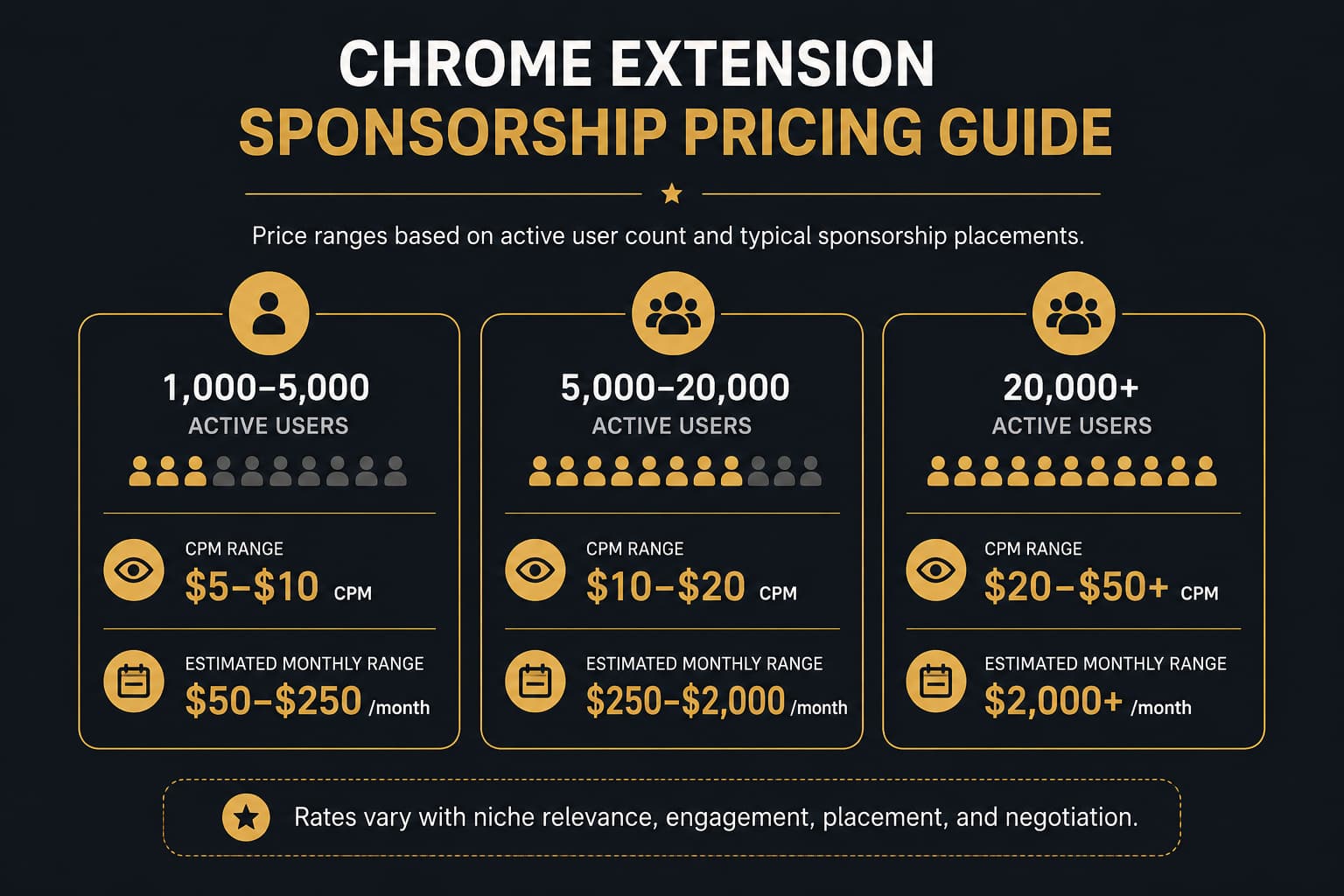
Sponsorship Pricing by User Base
| Active Users | Estimated CPM Rate | Monthly Sponsorship (Range) | Assumptions |
|---|---|---|---|
| 1,000–5,000 | $5–$10 | $50–$250 | Industry averages for niche audiences |
| 5,000–20,000 | $10–$20 | $250–$2,000 | Assumes a highly engaged user base |
| 20,000+ | $20–$50+ | $2,000+ | Dependent on niche and brand alignment |
Assumptions: Based on data from marketing and sponsorship resources (2024–2025). Assumes a niche extension with a clearly defined user demographic. Real outcomes will vary based on negotiation and brand interest.
How to Justify Your Rate
CPM (cost per thousand impressions) is the standard unit in digital advertising. If your extension popup loads for 3,000 active users per week, that's roughly 12,000 monthly impressions. At a $10 CPM for a niche audience, that's $120/month — a reasonable floor for a first deal, with room to negotiate up based on audience quality.
Don't forget that extension placements are often more valuable than banner ads. Your users are actively engaged with a tool they chose to install. That intent signal matters to brands.
Use Chrome Goldmine to benchmark your extension against others in your category — understanding the competitive landscape helps you justify your rate with data, not guesswork.
What to Include in Your Sponsorship Agreement
Once a brand says yes, you need a written agreement before you do any work. It doesn't have to be a legal contract drawn up by a lawyer — a clear email thread or a simple document works — but it must cover the basics.
Core Terms to Define
Deliverables: Exactly what is the brand getting? One placement in your popup? A shoutout in your onboarding modal? Be specific about format, size, and duration.
Duration: Is this a one-month deal, a three-month deal, or a single campaign? Set a clear start and end date.
Payment terms: When do you get paid? Net 30 (30 days after the sponsorship starts) is standard. Get at least 50% upfront from first-time sponsors.
Performance tracking: How will you report results? Agree upfront on what you'll measure — impressions, clicks, or installs — and how you'll share that data.
Content approval: Will the sponsor provide ad copy, or will you write it? Clarify who has final approval and how many revision rounds are included.
Beyond Sponsorships: Other Extension Revenue Strategies to Consider
Sponsorship is one tool in your monetization kit — not the whole toolkit. The indie makers who build sustainable income usually layer multiple revenue streams. For a full overview of all five proven models, see our monetization pillar guide.
Freemium with premium unlocks is the most common model. seeforcat's SuperDev Pro reached 6,000+ active users and sustainable income with zero marketing spend by building a product people recommended to each other (Reddit, 2025). A loyal free user base like that becomes leverage for both sponsorships and premium upgrades.
One-time payments via Gumroad or ExtensionPay work well for simpler utilities. ExtensionPay is purpose-built for browser extensions — it handles payments with no upfront cost, making it a low-friction option for indie developers (ExtensionPay). For more on this model, read our guide on how to sell your Chrome extension.
Selling the source code is less common but can generate a fast lump sum. One AI Chrome extension generated $3,500+ in two months by selling the codebase directly (Indie Hustle, 2024).
The SaaS market fueling demand for these tools isn't slowing down — it's projected to reach $465 billion by 2026 (Zylo, 2026). Brands will keep looking for niche audiences. Your job is to be ready when they come looking.
Conclusion
Landing your first chrome extension sponsorship doesn't require a massive user base or a business development team. It requires a clear audience profile, a credible store listing, a tight pitch, and the patience to find the right brand fit.
Start small: pick one or two SaaS companies that serve your users, send a short pitch, and have a one-page deck ready if they respond. Price your sponsorship based on real engagement data, not self-doubt. And always — always — confirm the deal in writing.
The extension ecosystem is growing fast. Brands are looking for niche, high-intent audiences that traditional advertising can't reach. That's exactly what your extension offers. If you're still building your audience, our guide on building a $1,000/month side income from Chrome extensions covers the portfolio strategy that gets you to sponsorship-ready user counts faster.
Before you pitch, make sure you understand where your extension sits in its niche. Chrome Goldmine gives you the benchmarking data you need to walk into a sponsorship conversation with confidence — not guesswork.