




Chrome Extension Pricing Strategies: What Actually Works in 2026
Compare freemium, subscription, and one-time pricing models, plus value-based and psychological tactics to price your extension right.

Article content
Are you an indie maker or vibe coder looking to monetize your next big Chrome extension idea? Understanding the right chrome extension pricing strategy is crucial for turning your passion project into a sustainable income stream. In 2026, the Chrome Extensions market is a vibrant ecosystem, projected to reach $5.0 Billion by 2033, offering immense opportunities for those who can effectively price their offerings. This comprehensive guide will walk you through various pricing strategies, help you validate your pricing with real users, and show you how to adapt your approach to maximize revenue and build a thriving micro-SaaS business. For a broader overview of monetization models, see our pillar guide on Chrome extension monetization.
Why Your Chrome Extension Pricing Strategy Matters More Than Ever
The Chrome Web Store is bustling with over 188,000 active extensions as of February 2026. While 94% of these extensions are free, the premium 6% generate an estimated 73% of the total revenue. This stark contrast highlights a critical truth: simply having a great extension isn't enough. Your pricing strategy is a direct reflection of your extension's perceived value and a powerful lever for growth. A well-thought-out pricing model can differentiate your product, attract the right users, and ensure long-term profitability in a competitive landscape. For indie makers, this means moving beyond guesswork and adopting a strategic approach to pricing.
Unpacking the Core Chrome Extension Monetization Models
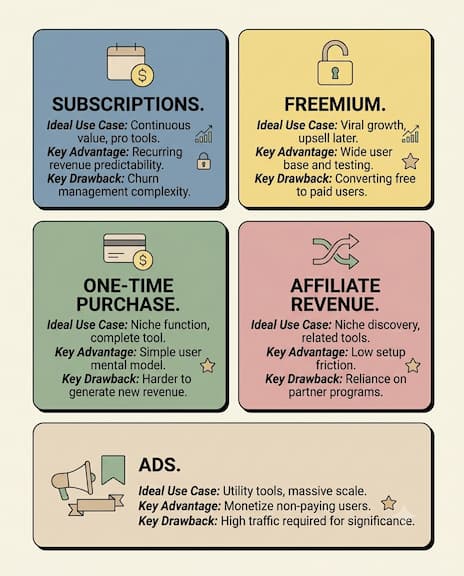
Before diving into specific pricing strategies, it's essential to understand the foundational monetization models prevalent in the Chrome extension ecosystem. These models dictate how users pay for your extension and form the basis for your overall pricing approach.
Freemium: The Dominant Model for User Acquisition
The freemium model, where a basic version of your extension is offered for free and advanced features are locked behind a paywall, is incredibly popular. Approximately 3.2% of paid extensions utilize this model. It's an excellent strategy for user acquisition, allowing a broad audience to experience your extension's core value before committing financially. The challenge lies in identifying which features to offer for free and which to reserve for premium users to encourage upgrades without alienating your free user base. Successful freemium extensions often provide significant value in their free tier, making the premium features feel like a natural, indispensable upgrade.
Subscription: Building Predictable Recurring Revenue
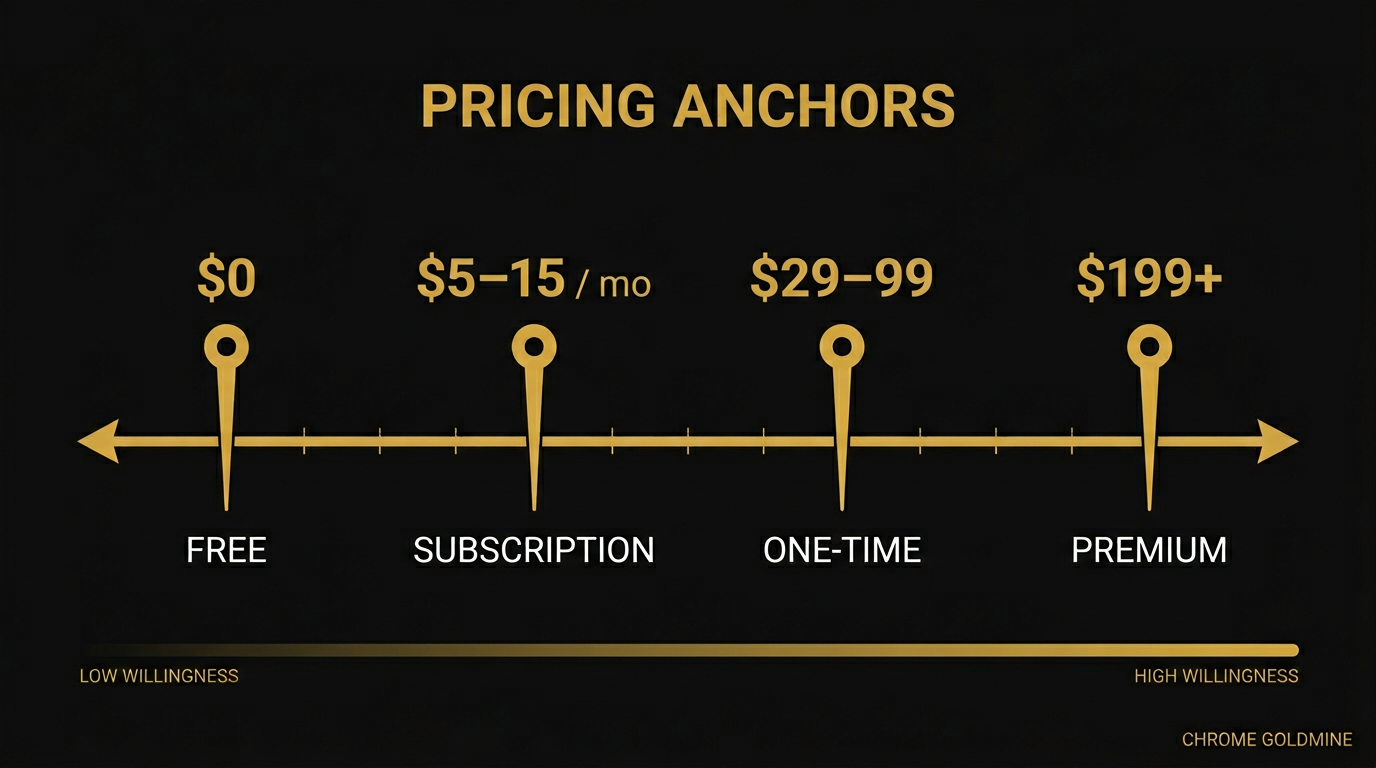
Subscriptions, accounting for 1.8% of paid extensions, are the gold standard for generating predictable recurring revenue (MRR). This model is particularly effective for extensions that provide ongoing value, such as productivity tools, cloud-synced features, or services with backend costs. Users pay a monthly or annual fee for continued access to features and updates. The average paid extension charges around $3.99/month or $29.99/year. The key to a successful subscription model is consistently delivering value that justifies the recurring cost and minimizing churn. For realistic income expectations at different user counts, see our revenue benchmarks guide — or model your own pricing against real benchmarks to see how ARPU changes shift MRR.
One-Time Purchase: Simplicity for Niche Tools
For simpler, utility-focused extensions that don't incur significant ongoing backend costs, a one-time purchase model (0.7% of paid extensions) can be effective. This model offers a straightforward value proposition: pay once, own forever. It appeals to users who prefer not to deal with recurring payments and can be particularly successful for niche tools that solve a specific, acute problem. The challenge here is ensuring the one-time price accurately reflects the lifetime value of the extension and covers your development costs. If you're considering a one-time payment launch, our lifetime deal guide covers AppSumo and PitchGround strategies in detail.
What Doesn't Work (and Why): Common Pricing Pitfalls
Many indie makers stumble when it comes to pricing their Chrome extensions, often due to a few common misconceptions. One significant pitfall is underpricing your extension because you believe users expect extensions to be free or very cheap. This often stems from a lack of confidence in the value you provide or an over-reliance on competitive pricing without understanding the competitor's cost structure or target audience.
Another common mistake is failing to validate your pricing with target users. Launching with an arbitrary price point without understanding what your audience is willing to pay can lead to low conversion rates or, conversely, leaving money on the table. Without user feedback, you might be guessing rather than strategizing. Your pricing should reflect the unique problem you solve and the value you deliver.
Advanced Chrome Extension Pricing Strategies for Growth
Moving beyond basic monetization models, several strategic approaches can help indie makers optimize their chrome extension pricing strategy for sustained growth and profitability.
Value-Based Pricing: Aligning Price with Perceived Benefit
Value-based pricing is arguably the most effective strategy for indie makers. Instead of focusing on your costs or competitor prices, you set your price based on the perceived value your extension delivers to the customer. If your extension saves users hours of work, generates significant leads, or provides unique insights, its price should reflect that tangible benefit. For example, Guilherme Rizzo's CSS Scan achieved over $70,000 in sales by offering a clear, high-value solution to a common developer pain point. To implement this, deeply understand your user's problems and quantify the impact your solution provides.
Competitive Pricing: Strategic Positioning in a Crowded Market
While not the sole determinant, competitive pricing plays a role, especially in crowded categories. This strategy involves setting prices relative to your competitors. However, it's crucial to differentiate. If you offer a superior feature set or a more refined user experience, you might justify a premium price. Conversely, if you're entering a mature market, a slightly lower price could attract early adopters. The key is not just to match prices but to understand your competitive advantages and position your pricing accordingly. Remember, 72% of extensions have fewer than 1,000 users, so standing out with a clear value proposition is paramount. Use Mangools to research keyword volume and competition for your extension's niche.
Psychological Pricing: Leveraging Human Behavior
Psychological pricing taps into human cognitive biases to influence purchasing decisions. These strategies can significantly impact conversion rates when applied thoughtfully:
- Charm Pricing: Ending prices with .99 (e.g., $4.99 instead of $5.00) makes a price appear significantly lower.
- Anchoring: Presenting a higher-priced option first makes subsequent lower-priced options seem more attractive.
- Bundling: Offering multiple features or extensions together at a slightly reduced price can increase perceived value.
- Tiered Pricing: Offering different tiers (e.g., Basic, Pro, Enterprise) allows users to self-select based on their needs and budget, often making the middle tier the most appealing.
How to Validate Your Pricing Before Launch
One of the biggest challenges is knowing if your chosen chrome extension pricing strategy will resonate with your audience. Here's how to validate it:
- Conduct User Interviews: Talk to your target users. Ask them about their current pain points, how they solve them, and what they would be willing to pay for a solution like yours.
- A/B Testing (Post-Launch): Once live, experiment with different price points or pricing models. Tools like ExtensionPay or BrowserBill can help manage payment flows and track conversions. For an all-in-one solution that handles subscriptions, pricing tiers, and CRM without stitching together multiple tools, Outseta is worth evaluating.
- Competitor Analysis with a Twist: Don't just look at what competitors charge; analyze *how* they charge and *what value* they emphasize. Identify gaps in their pricing strategies that you can exploit.
- Pre-launch Surveys and Landing Pages: Before you even build, create a landing page describing your extension and its proposed pricing. Use surveys to gauge interest and willingness to pay. For more on this, see our guide on validating Chrome extension ideas.
Is a Chrome Extension Worth Your Time? ROI Analysis
For indie makers and vibe coders, the question isn't just *how* to price, but *if* building and pricing a Chrome extension is a worthwhile endeavor. The answer, backed by real-world success stories, is a resounding yes — if approached strategically. While 72% of extensions have fewer than 1,000 users, successful ones can generate substantial income. For instance, Kim Dang's Group Convert extension generates over $840,000 per year, showcasing the immense potential.
| Time Investment (hours) | Monetary Investment ($) | Expected Outcome (range) | Assumptions |
|---|---|---|---|
| 80–300 hours | $5–$500 | $200–$5,000 MRR | Median freelance rates, typical MVP dev time, successful indie extension conversion rates |
Small niche extensions can earn a few hundred dollars per month, while established extensions with over 100,000 users can generate $10,000 to $50,000+ per month. Even reviving abandoned extensions can lead to $200–$40,000 MRR. The initial $5 Chrome Web Store developer account fee is a minimal barrier to entry, making the risk-reward profile highly attractive. Smart pricing also compounds into exit value — our breakdown of how much a 10,000-user Chrome extension is worth shows how ARR multiples turn monthly revenue into a five-figure asset. To build quickly, check out our vibe coding tools comparison — or use Launchfast for pre-built Chrome extension starter kits that get you to market faster.
Conclusion: Your Path to a Profitable Chrome Extension
Mastering your chrome extension pricing strategy is not a one-time decision but an ongoing process of learning, testing, and adapting. By understanding the market, choosing appropriate monetization models, and applying strategic pricing techniques like value-based and psychological pricing, indie makers can significantly increase their chances of success. Remember to validate your pricing with real users and be prepared to iterate based on feedback and market dynamics.
Ready to turn your Chrome extension idea into a profitable venture? Don't waste time sifting through countless extensions. Chrome Goldmine provides a curated database of high-potential, expired Chrome extensions, offering a shortcut to validated opportunities. Discover your next profitable extension idea today! Browse our recommended tools and platforms to accelerate your journey. To ship your extension in minutes, check out TurboStarter — a starter kit built for rapid browser extension deployment. You can also explore sponsorship deals as a complementary revenue stream that doesn't require payment infrastructure.