






Best Expired Chrome Extensions by Category 2026
Which categories leave the most abandoned users behind: productivity, email and dev tools ranked by install base, revenue potential and rebuild difficulty.

Article content
Over 100,000 Chrome extensions have been discontinued or abandoned in the past 5 years, but that's the best news you'll get all day. For indie makers, this digital graveyard is a goldmine of proven ideas, abandoned user bases, and validated market demand. The best expired Chrome extensions to rebuild in 2026 are those in high-demand categories like productivity, developer tools, and e-commerce, where users have already shown a willingness to pay for solutions. This comprehensive expired chrome extensions list will guide you through the most profitable opportunities. Ready to find your next opportunity? Start with the Chrome Goldmine database to filter extensions by category, revenue potential, and development time.
In this pillar post, you will learn how to:
- Identify high-potential extension categories with proven user demand and monetization models.
- Discover which expired extensions offer the most significant revenue opportunities for indie makers.
- Validate ideas before you build to avoid common pitfalls and maximize your chances of success.
Why Are Expired Chrome Extensions a Goldmine for Indie Makers in 2026?
The Chrome Web Store is a landscape of constant change. Between 2020 and 2024, the number of available extensions dropped from 137,345 to 111,933, a staggering 18.5% decline. That represents over 25,000 extensions that were discontinued, abandoned, or removed. This trend is accelerating with Google's enforcement of Manifest V3, which will disable all non-compliant extensions by June 2025. For indie makers, this isn't a crisis; it's a once-in-a-decade opportunity.
Each discontinued extension leaves behind a trail of breadcrumbs: a proven user base, validated market demand, and a clear feature set that solved a real problem. While 70% of micro-SaaS founders earn less than $1,000 per month, rebuilding a well-chosen expired extension can shortcut the path to profitability. Case studies show indie makers reaching $200-$40,000 in monthly recurring revenue (MRR) by reviving abandoned extensions, often achieving profitability in just 3-6 months. The browser extension market is a $7.8 billion industry, and the wave of discontinuations is opening new doors for savvy developers. Use our decision framework to evaluate which extensions are worth rebuilding.
Data analysis is the latest goldmine.
— My Reliq (@myreliq) February 16, 2026
Which Expired Extension Categories Have the Most Revenue Potential?
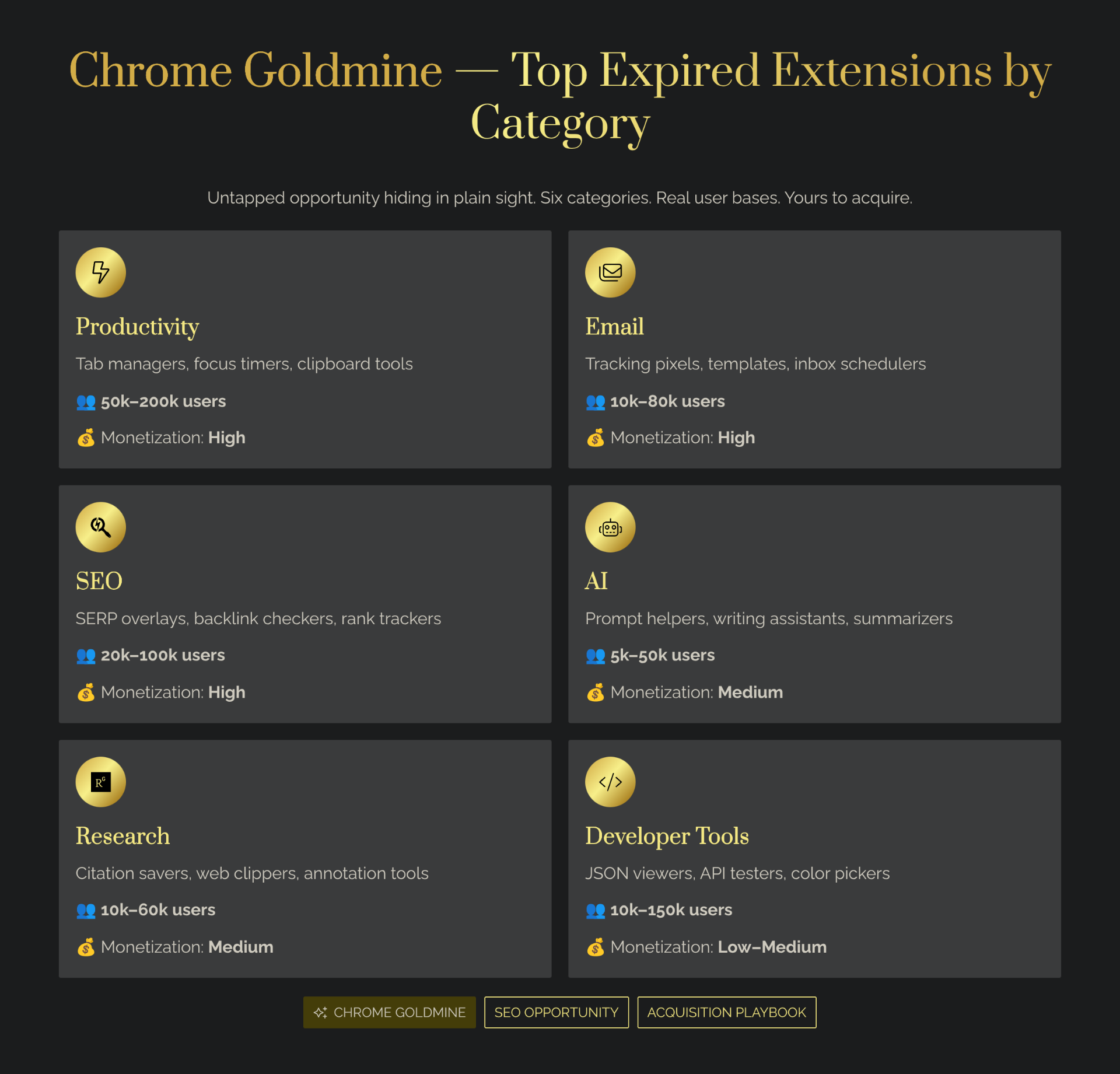
Not all expired extensions are created equal. The most profitable opportunities lie in categories where users have high intent and a willingness to pay for solutions that save them time, make them money, or streamline their workflows. Based on our analysis of revenue data and case studies, the following categories offer the highest potential for rebuilds in 2026:
- Developer Tools: Highest monetization potential, with MRR ranging from $1,000 to $4,000+. Developers are accustomed to paying for tools that improve their productivity.
- Productivity & Automation: A massive category where even a small niche can be highly profitable. MRR typically ranges from $200 to $1,500+.
- Email & Communication: High user demand for tools that manage inboxes and streamline communication. MRR potential is strong, often in the $500-$2,500 range.
- E-commerce & Shopping: Driven by affiliate revenue, these extensions can generate significant income ($25K-$40K MRR) with a large user base.
- Data Management & Integration: Sticky products with high switching costs, making them ideal for recurring revenue models.
- Social Media & Content Creation: Lower ARPU but often faster to build and can attract large user bases quickly.
Productivity Extensions That Shut Down: The Top Opportunities
Productivity is the largest and most competitive category in the Chrome Web Store, with over 62,000 extensions. It's also a graveyard of abandoned tools. The high competition means many developers burn out or move on, leaving behind thousands of users. This creates a prime opportunity for indie makers to step in and provide a better, more focused solution. For more on this category, see our analysis of productivity extensions that shut down.
Automation Extensions with Abandoned User Bases
Automation tools that perform repetitive tasks are incredibly valuable. When they disappear, users are left scrambling for alternatives. Look for extensions that automated workflows, filled forms, or scraped data. These often have dedicated user bases willing to pay for a reliable replacement. For a deep-dive on validating these ideas, see our guide on how to validate an expired extension idea before rebuilding.
Note-Taking & Organization Tools No Longer Maintained
Note-taking and bookmarking tools are another area ripe for rebuilds. Many of these were solo projects that were abandoned after the initial excitement wore off. A prime example is "Readdit Later," a Chrome extension for managing saved Reddit posts. The creator reached 650 users and $200 in revenue within 45 days of adding a paywall, proving that even a niche organization tool can find a paying audience. Explore alternatives in our Todoist alternative extensions guide.
Email & Communication Extensions: A Market Ripe for Rebuilds
Email remains the backbone of business communication, and users are constantly seeking ways to make it more efficient. However, email extensions are notoriously difficult to maintain due to constant updates from email providers and the high security standards required. This leads to a high rate of discontinuation. For example, WAToolkit, a popular extension for WhatsApp, was compromised and removed, leaving its users searching for a replacement. This creates a significant opportunity for developers who can provide a secure and reliable alternative. The demand for email productivity is strong, with case studies showing that extensions in this category can generate $500-$2,500 MRR. Learn more in our dedicated email extension opportunities guide.
Development & Coding Tools: Where Indie Developers Win
Developers are a unique audience: they are highly technical, appreciate well-crafted tools, and are willing to pay for solutions that save them time and effort. This makes the developer tools category one of the most lucrative for indie makers. While the development time might be longer (250-500 hours), the monetization potential is significantly higher, with successful extensions reaching $1,000-$4,000+ MRR.
Developer Tool Extensions with Proven Revenue
Many developer-focused extensions have been discontinued due to the Manifest V3 transition or because their creators moved on to other projects. This leaves a gap in the market for tools that help with debugging, code formatting, and API testing. A real-world example is a code formatter extension that, despite being a one-time purchase of $9.99, generated $75,000 in its first year from 150,000 installs. This demonstrates the high demand for specialized developer utilities.
How to Monetize Dev-Focused Extensions
Unlike other categories, developers are often receptive to one-time purchase models, especially for tools that provide lasting value. However, subscription models can also be successful, particularly for extensions that require ongoing maintenance and updates. Outseta makes it straightforward to offer both one-time and subscription billing from a single platform. The key is to offer a clear value proposition and a pricing model that aligns with the developer workflow. For a deeper look at pricing strategies, see our guide on how to monetize an expired Chrome extension.
Social Media & Content Creation Tools: Dormant Goldmines
Social media and content creation extensions often have high user engagement but can be challenging to monetize, leading to many being abandoned. This category is a goldmine for indie makers who can find a niche with a passionate user base. For example, extensions that enhance Twitter, Reddit, or YouTube with new features or improved workflows have a built-in audience. While the average revenue per user (ARPU) might be lower than in other categories, the potential for high user volume can compensate for this. The key is to identify a specific pain point and offer a focused solution.
Data Management & Integration Extensions: Growing Category
Integration extensions that connect different web services are incredibly sticky. Once a user incorporates an extension into their workflow, they are unlikely to switch unless a better alternative comes along. This makes them ideal for recurring revenue models. Many of these extensions are discontinued because they are difficult to maintain, especially when the APIs of the services they connect to change. This creates an opportunity for developers who are willing to keep up with these changes. Pricing models for integration extensions can be based on the number of connections, the volume of data transferred, or a simple monthly subscription.
What Makes a Discontinued Extension Worth Rebuilding?
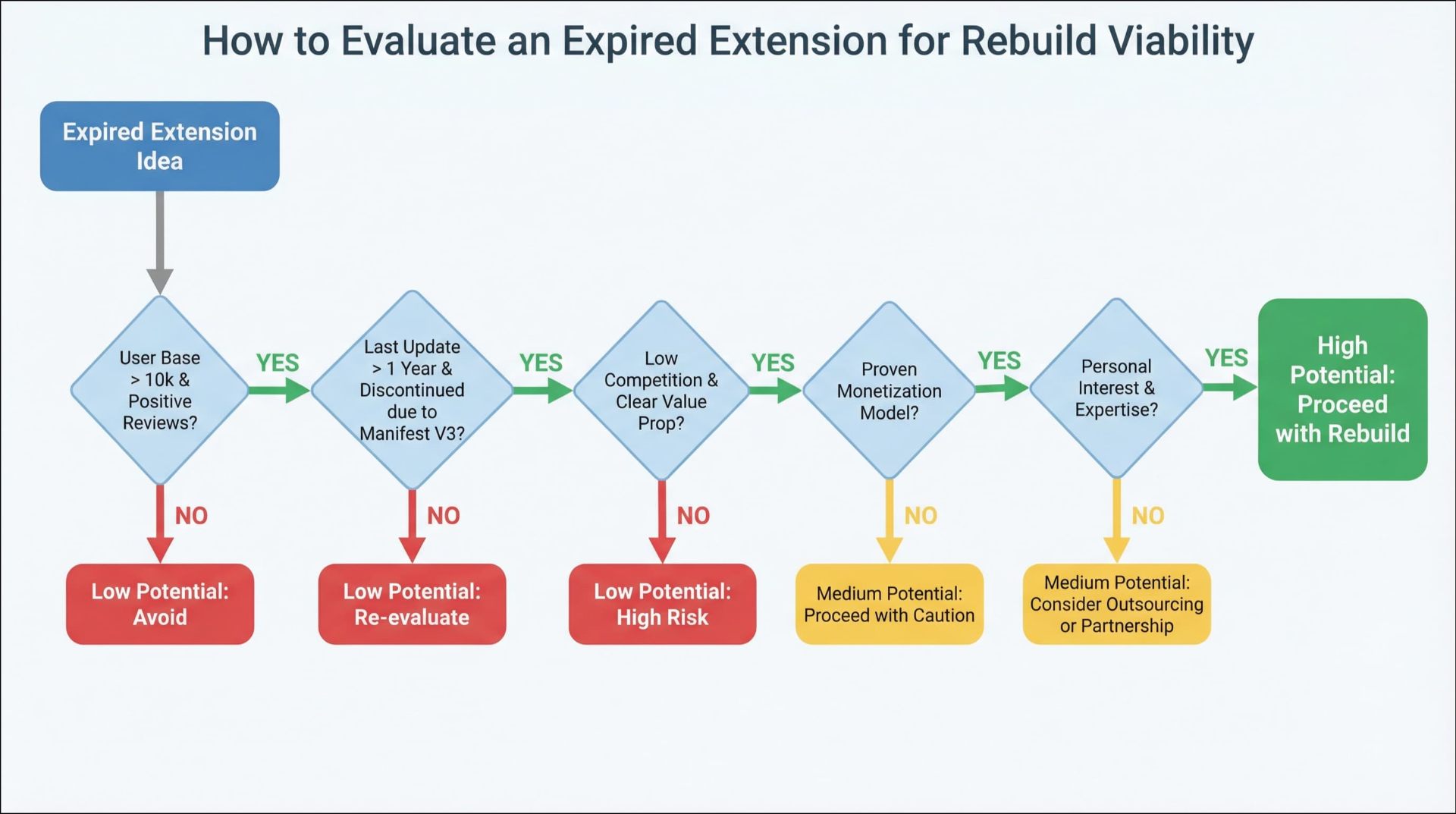
Not every abandoned extension is a hidden gem. To avoid wasting time on a dead end, you need a solid validation framework. Before you write a single line of code, evaluate the opportunity based on the following criteria. For the complete framework, read our comprehensive guide to expired Chrome extensions.
Your Validation Checklist
- Original User Base & Reviews: Did the extension have a significant number of users (10,000+)? Are there positive reviews on the Chrome Web Store or other platforms? This indicates a passionate user base that may be looking for a replacement.
- Last Update & Reason for Discontinuation: When was the extension last updated? If it was abandoned due to the Manifest V3 transition, that's a strong signal. If it was removed for security reasons, proceed with caution.
- Competitor Landscape: Are there already several alternatives? If so, can you offer a unique value proposition or a better user experience? For a full breakdown of how to assess the market, see our guide on how to rebuild vs. build a new Chrome extension.
- Monetization Potential: Was the original extension paid? Are users in this category accustomed to paying for tools? This will help you determine if you can build a sustainable business.
- Personal Interest & Expertise: Are you passionate about this category? Do you have the skills to build and maintain the extension? Your own motivation is a critical factor in long-term success.
Red Flags to Avoid
- Low User Count & Poor Reviews: If the original extension had few users and negative feedback, it's a sign that the problem wasn't worth solving in the first place.
- Saturated Market with Strong Competitors: If there are already several well-established alternatives, it will be difficult to gain traction.
- Complex Technology & High Maintenance: Avoid extensions that require complex backend infrastructure or constant maintenance, unless you have the resources to support them.
Common Mistakes When Rebuilding Expired Extensions
Rebuilding an expired extension can be a shortcut to a profitable micro-SaaS, but it's not without its pitfalls. Many indie makers waste 4-6 weeks rebuilding extensions without checking if the original user base still exists or if the problem is still relevant. One of the most common mistakes is rebuilding an extension without validating current user demand. Just because an extension was popular in 2022 doesn't mean it's still needed in 2026. Tastes change, workflows evolve, and new tools emerge. Another common failure scenario is choosing a saturated category without a clear differentiator. If there are already a dozen alternatives, you need a compelling reason for users to switch to your product. Our guide on finding expired extension ideas walks you through proper research methods to avoid these mistakes.
Is Rebuilding an Expired Extension Worth Your Time?
Before diving into development, it's crucial to understand the potential return on investment (ROI). While every project is different, we can estimate the time and monetary investment required for various categories, along with the expected monthly recurring revenue (MRR). This table is based on our analysis of indie maker case studies and development cost data for 2026. For detailed chrome extension revenue benchmarks by user count, see our dedicated guide.
| Category | Time Investment | Monetary Investment | Expected MRR (Range) | Assumptions |
|---|---|---|---|---|
| Productivity Tool | 200–400 hours | $500–2,000 | $200–1,500/mo | Based on indie maker case studies; assumes 1,000–5,000 active users at $0.10–$0.30 ARPU |
| Email Integration | 150–300 hours | $1,000–3,000 | $500–2,500/mo | Payment integration + API costs; higher ARPU (B2B focus) |
| Dev Tool | 250–500 hours | $2,000–5,000 | $1,000–4,000/mo | Highest monetization potential; requires strong marketing |
| Social Media Tool | 100–200 hours | $300–1,000 | $100–500/mo | Lower ARPU; high competition |
Assumptions: Based on publicly disclosed indie maker revenue from Indie Hackers case studies (2024–2026). Assumes medium skill level (1–3 years extension development experience). MRR ranges are estimates; real outcomes vary significantly based on marketing, category saturation, and user validation. Does not include ongoing maintenance or customer support time.
The Next Steps: From Idea to Launch
Now that you have a clear understanding of the opportunities in the expired Chrome extension market, it's time to take action. For a structured 48-hour sprint from idea to published extension, try our Weekend Challenge. The path from idea to a profitable micro-SaaS is a clear one: validate, build, and monetize. Instead of manually reviewing thousands of discontinued extensions, you can use our categorized Chrome Goldmine database to filter by time investment, expected revenue, and market demand. This will help you shortcut your research and focus on the most promising opportunities.
Once you've identified a promising expired extension to rebuild, you'll need a solid development environment, a monetization platform, and analytics tools. Use Mangools for keyword validation, Outseta for billing and user management, and an AI builder to accelerate development. Our comprehensive guides on monetization strategies for extensions and running effective market analysis will walk you through the best options for each stage of your journey. The opportunity is clear, the roadmap is laid out, and the tools are available. The only question left is: which expired extension will you rebuild?
References
- DebugBear. (2024). *Chrome Extension Statistics: Data From 2024*
- About Chromebooks. (2025). *Which Chrome Extensions Were Banned in 2024–25?*
- [Rocking Web. (2025). *1,000 Micro SaaS Analysed: Real Revenue Data [2025 Study]*](https://www.rockingweb.com.au/micro-saas-revenue-analysis-2025)
- Reddit. (2025). *I hit 650 users and $200 revenue in 45 days with my Chrome extension*
- Right Tail. (2025). *Can You Earn Money Making Chrome Extensions?*
- Forbes. (2025). *Extending E-Commerce Revenue With Browser Extensions*
See every category, not just the top ones
Browse all 9,656 expired extensions by category with install base, revenue estimate and rebuild difficulty for each.
$23.20 $29 · 20% off for the first 100 buyers · one-time payment