




How to Validate Expired Extension Ideas Before Building
A 5-part framework to validate user demand, market size, and monetization for your extension idea in 40 hours, not 400.

Article content
Most indie makers build first, validate later. You should validate first—it takes 40 hours instead of 400. Here's exactly how. This guide provides a 5-part framework to help you validate your extension idea in a fraction of the time it takes to build, saving you time, money, and the frustration of building the wrong thing. For market context, see our 2026 Market Analysis. Still picking what to validate? Browse our list of easy Chrome extension ideas you can build and validate fast for low-complexity starting points.
We will explore the costs of skipping validation, the five key areas to validate, and a step-by-step process for gathering the data you need to make an informed decision. By the end of this guide, you will have a clear understanding of how to de-risk your extension idea and increase your chances of success. Once validated, learn how to monetize your extension effectively.
Why Validation Matters (The Cost of Skipping It)
Skipping validation is a costly mistake that many indie makers make. The allure of building a new product can be strong, but without proper validation, you are likely to waste a significant amount of time and money on an idea that has no market.
Opportunity Cost
The most significant cost of skipping validation is the opportunity cost. The average Chrome extension can take anywhere from 100 to 300 hours to build, and that is time that you could have spent on a more promising idea. One indie hacker spent 8 months and $3,500 building a job automation tool, only to find that no one was interested in it. A few weeks of validation could have saved him a significant amount of time and money. Our decision framework can help you avoid this kind of costly mistake.
Risk Mitigation
Validation is all about mitigating risk. By talking to potential users and gathering feedback on your idea, you can significantly increase your chances of success. The failure rate for new extensions is high, with some estimates suggesting that the majority of new projects fail within the first 30 days. Validation can help you avoid the common pitfalls that lead to failure, such as building a product that no one wants or solving a problem that doesn't exist.
Timeline to Profitability
A validated idea has a much shorter timeline to profitability than a non-validated one. When you have a clear understanding of your target market and their needs, you can build a product that is more likely to resonate with them. This can lead to a faster path to revenue and a more sustainable business in the long run.
The 5-Part Validation Framework
To effectively validate your extension idea, you need a structured approach. This 5-part framework covers the critical areas you must investigate before writing a single line of code. We will briefly introduce each part here and then dive deeper into the specifics in the following sections. If you're still exploring which category to focus on, check our best expired extensions by category 2026 guide first.
Part 1: User Base Validation
This is the most critical part of the framework. You need to determine if there is a real audience for your extension. Do people actually want what you are planning to build? How many potential users are there, and what specific problem are they trying to solve? Answering these questions requires direct interaction with potential users.
Part 2: Market Sizing
Once you have confirmed that there is a user base for your idea, you need to determine if the market is large enough to be viable. This involves estimating the Total Addressable Market (TAM), Serviceable Available Market (SAM), and Serviceable Obtainable Market (SOM). This analysis will help you understand the revenue potential of your idea and whether it aligns with your financial goals.
Part 3: Competitive Analysis
No idea exists in a vacuum. You need to understand the competitive landscape and determine how your extension will stand out. Who else is solving this problem? What are their strengths and weaknesses? A thorough competitive analysis will help you identify your unique value proposition and develop a clear differentiation strategy.
Part 4: Revenue Model Validation
A great idea is not a business until it generates revenue. You need to validate whether users are willing to pay for your solution and what pricing model is most appropriate. This involves testing different price points and monetization strategies, such as freemium, subscription, or a one-time purchase.
Part 5: Build Feasibility Check
Finally, you need to be honest with yourself about your ability to execute the idea. Do you have the technical skills to build the extension, or will you need to hire a developer? AI builders like Lovable and Bolt have dramatically lowered the technical bar—once validated, follow our step-by-step Claude tutorial to build your first extension in 30 minutes. How long will it take to build, and what resources will you need? A realistic assessment of your capabilities will help you avoid getting in over your head.
Part 1 - User Base Validation (Finding Real Users)
User base validation is where the rubber meets the road. It is the process of getting out of your own head and talking to real people to see if they have the problem you think they have. This is the most important part of the validation process, and it is the one that most indie makers skip.
Method 1: Subreddit Outreach
Subreddits are a goldmine for user research. Find subreddits that are relevant to your idea and start engaging with the community. For example, if you are building a Todoist extension, you could post in r/productivity, r/productivity_tools, and r/todoist. The key is to be a genuine member of the community, not a spammer. Ask open-ended questions and listen to the feedback you receive. For more on using Reddit for extension research, see our guide on finding expired extension ideas.
Method 2: Community Forums
In addition to Reddit, there are a number of other community forums where you can find potential users. Twitter/X, Indie Hackers, and Product Hunt are all great places to find people who are passionate about productivity and technology. Search for keywords related to your idea and join the conversation.
Method 3: Existing Tool Communities
If you are rebuilding an expired extension, the community around the original tool is a great place to start. For example, if you are rebuilding a Todoist extension, you could visit the Todoist subreddit and ask users where they went after the original extension was discontinued. This can give you valuable insights into the needs of the market.
Method 4: LinkedIn Messaging (for B2B)
If you are building a B2B extension, LinkedIn is a great place to find potential users. You can search for people by job title, industry, and company size, and then reach out to them with a personalized message. The key is to be respectful of their time and to offer them something of value in return for their feedback.
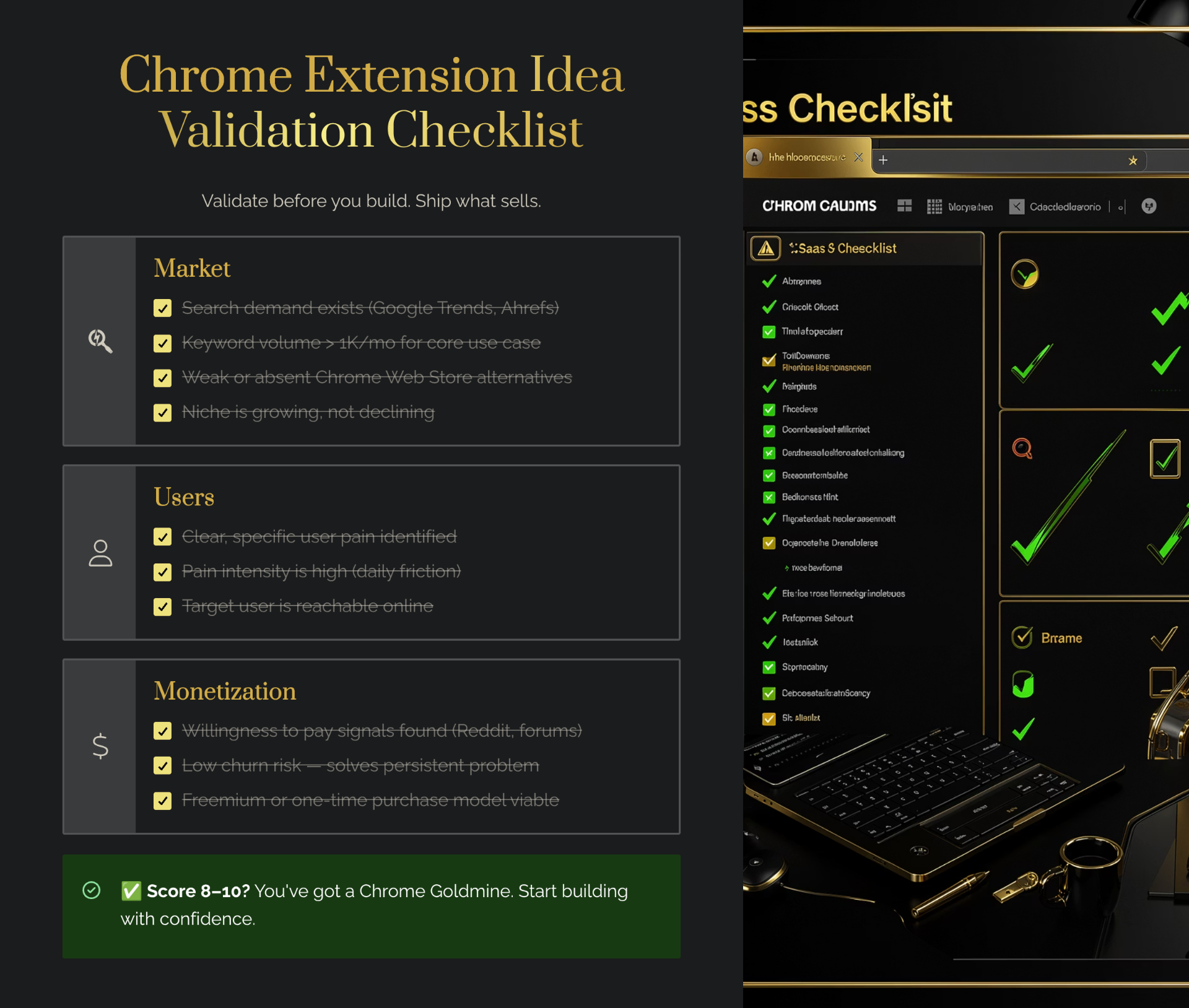
Validation Checklist
To ensure that you are getting the most out of your user research, here is a checklist of things to keep in mind:
- Talked to 5+ potential users
- Heard the same problem 3+ times
- Know why they would use your extension
- Understand their workflow
- Got honest feedback (not just "cool!")
- Know their budget / willingness to pay
- Asked about competitors (what they currently use)
- Got permission to follow up
- Have a clear next step (beta, waitlist, etc.)
Part 2 - Market Sizing (Is It Big Enough?)
Once you have validated that there is a real user need for your extension, the next step is to determine if the market is large enough to support your business. This is where market sizing comes in.
TAM/SAM/SOM Analysis
A simple way to think about market sizing is to use the TAM/SAM/SOM framework:
- Total Addressable Market (TAM): This is the total market demand for a product or service. For a Todoist extension, the TAM might be all 50 million productivity app users.
- Serviceable Available Market (SAM): This is the segment of the TAM that you can realistically reach with your product. For a Todoist extension, the SAM might be the 5 million users of Todoist and its alternatives.
- Serviceable Obtainable Market (SOM): This is the portion of the SAM that you can realistically capture in the first year. For a Todoist extension, the SOM might be 50,000 to 100,000 users.
Competitive Benchmarking
Another way to size the market is to look at the competition. If there are other extensions that are solving a similar problem, you can use their user numbers as a benchmark. If the extension you are rebuilding was popular, you can look at its peak user base to get an idea of the market size. Our Todoist alternative analysis is a great example of how to benchmark against competitors in the productivity space.
Revenue Potential Calculation
Finally, you need to calculate the revenue potential of your idea. You can do this by multiplying the number of users you expect to have by the average revenue per user. For example, if you expect to have 10,000 users and you charge $5 per month, your monthly recurring revenue would be $50,000. Skip the spreadsheet and run your numbers with our revenue calculator to instantly see MRR, ARR, and timeline to profitability at different conversion rates. Use the Chrome Goldmine database to find comparable extension data, and cross-reference with Mangools to validate that search demand actually exists for your target keywords before committing.
Part 3 - Competitive Analysis (Are You Differentiated?)
No matter how unique you think your idea is, there is a good chance that someone else is already solving a similar problem. That is why it is so important to do a thorough competitive analysis before you start building.
Direct Competitors
Direct competitors are other extensions that are solving the same problem as you. You need to identify these competitors and analyze their strengths and weaknesses. Are they actively maintained? Are they growing? What features do they have? This analysis will help you identify opportunities to differentiate your product.
Indirect Alternatives
Indirect alternatives are other products or services that are solving the same problem as you, but in a different way. For example, if you are rebuilding a Todoist extension, the Todoist web app is an indirect alternative. You need to understand why users might choose these alternatives over your extension and how you can position your product to compete with them.
Differentiation Matrix
A differentiation matrix is a simple tool that you can use to compare your product to the competition. Create a table with your features on one axis and your competitors on the other. This will help you identify where you have a competitive advantage and where you need to improve.
| Feature | Your Idea | Competitor 1 | Competitor 2 |
|---|---|---|---|
| Quick Capture | Excellent | Good | Good |
| Smart Parsing | Excellent | Limited | Medium |
| Multi-inbox | Limited | N/A | Varies |
| Team Collaboration | Limited | No | Some |
Part 4 & 5 - Revenue + Build Feasibility
The final two parts of the validation framework are revenue and build feasibility. These are often overlooked, but they are just as important as the other three.
Monetization Validation
To validate your monetization strategy, you need to talk to potential users and ask them if they would be willing to pay for your product. You can also look at what your competitors are charging and use that as a benchmark. The key is to have a clear monetization strategy from day one. Our guide on expired email extensions provides a great example of a validated category with proven monetization models.
Technical Feasibility
Finally, you need to be honest with yourself about your ability to build the product. Do you have the technical skills to build the extension, or will you need to hire a developer? How long will it take to build, and what resources will you need? A realistic assessment of your capabilities will help you avoid getting in over your head.
What Doesn't Work (Common Validation Mistakes)
There are a number of common mistakes that indie makers make when they are validating their ideas. Here are a few to avoid:
- Building a product in search of a problem: This is the most common mistake that indie makers make. They fall in love with an idea and then try to find a problem that it solves. The key is to start with a problem and then build a solution.
- Ignoring the competition: No matter how unique you think your idea is, there is a good chance that someone else is already solving a similar problem. You need to do a thorough competitive analysis to understand the landscape and identify opportunities to differentiate your product.
- Not talking to users: This is the most important part of the validation process. You need to get out of your own head and talk to real people to see if they have the problem you think they have.
Conclusion: Build with Confidence
Validating your extension idea is a critical step in the product development process. By taking the time to do it right, you can significantly increase your chances of success. The 5-part framework in this guide provides a structured approach to validation that will help you de-risk your idea and build a product that people actually want.
Ready to start building? Our Complete Guide to Expired Chrome Extensions provides a step-by-step framework for finding, validating, and building your own profitable extension.
Looking for more raw signal? Comb through Chrome extension ideas on Reddit for unmet demand threads, and see how a curated Chrome extension ideas database compares to open scraping.