





How to Build and Launch a Micro-SaaS in 2026: The Indie Maker Guide
Find a painful niche problem, vibe code the MVP, and launch a lean micro-SaaS — with 2026 market stats and realistic ROI tables.
Article content
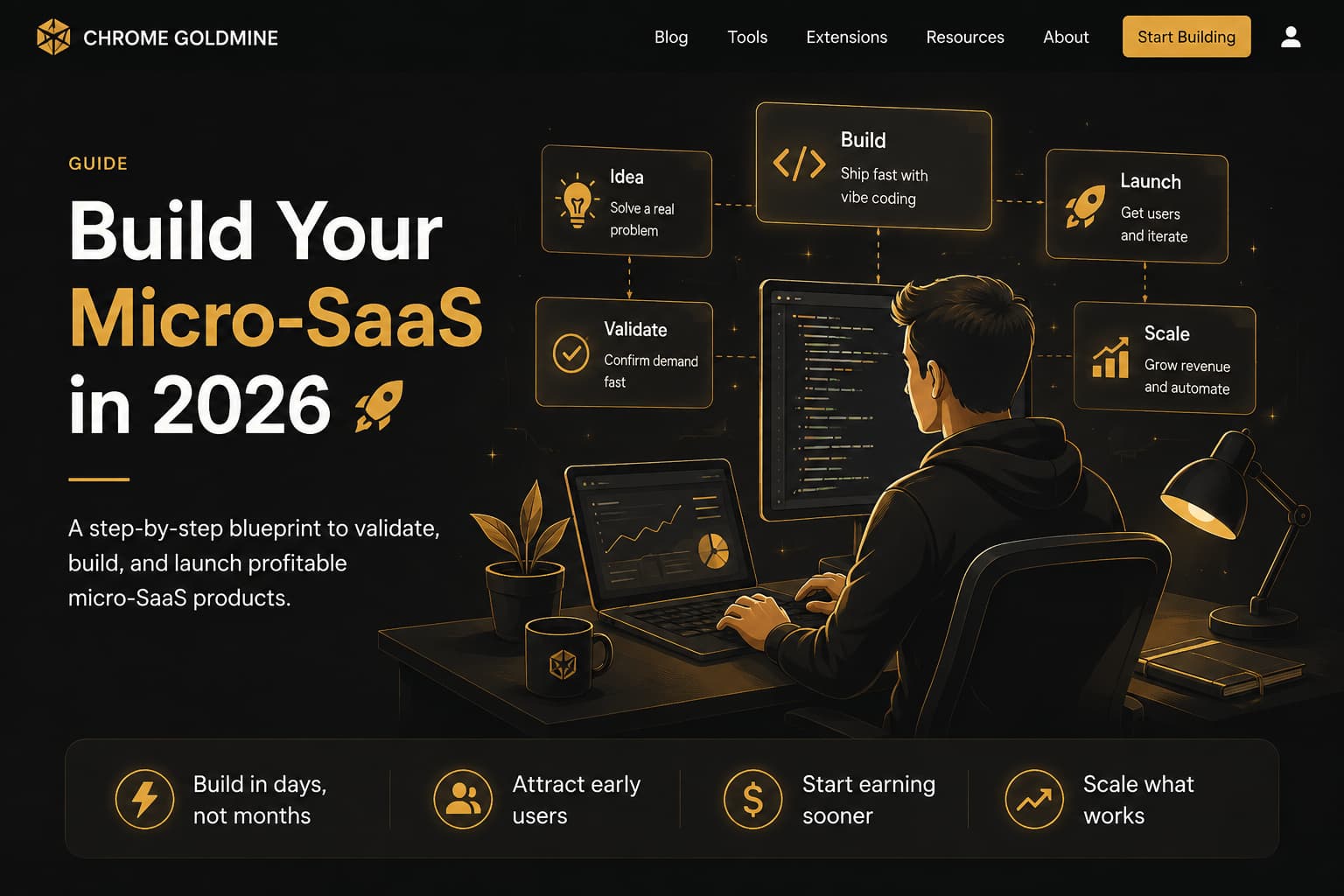
Building a micro-SaaS in 2026 is about finding a narrow, painful problem and solving it with a lean, AI-powered tool that you can manage alone. You can launch a profitable product in weeks, not months, by leveraging modern "vibe coding" workflows and niche distribution channels like the Chrome Web Store.
The global SaaS market is projected to reach $375.57 billion this year, and for indie makers, the opportunity has never been greater. With 95% of independent SaaS businesses reaching profitability within their first year, the path from "idea" to "income" is clearer than ever.
What Makes Micro-SaaS Profitable in 2026?
In 2026, profitability comes from low overhead and high automation. Unlike traditional startups that require venture capital and large teams, a micro-SaaS is designed to be run by a single person. The rise of AI agents has drastically lowered the "vibe coding" barrier, allowing you to describe features in plain English and have them built instantly. For the exact tools to build your micro-SaaS, see our vibe coding tools comparison.
For example, tools like Bolt.new allow you to prompt entire full-stack applications into existence — and if you've never written a line of code, our no-code Chrome extension guide walks through the same workflow end to end. This shift means your primary investment is no longer "coding time" but "problem discovery." Use Mangools to validate that people are actually searching for your solution — if the keyword volume is there, demand is confirmed. When you solve a specific problem for a specific group—like automating SEO reports for local plumbers—you create a "sticky" product with high retention.
How Much Can You Actually Earn with a Micro-SaaS?
Revenue in the micro-SaaS space varies wildly, but the floor for a successful niche product is often higher than a traditional salary. Case studies like Gmass, which generates $130,000 per month as a Chrome extension, show the massive ceiling of "small" tools.
Even smaller wins are significant. QR Code AI reached $4,800 in monthly recurring revenue (MRR) just one month after launch. The key is to focus on recurring value. If your tool saves a user two hours of work every week, a $20/month subscription becomes an easy "yes." Curious what those numbers look like for your idea? Model your micro-SaaS revenue potential with different user counts and conversion rates before you write a line of code.
What Doesn't Work (and Why)
The biggest mistake indie makers make in 2026 is "building in a vacuum." Many founders spend months perfecting a feature set that nobody actually wants. According to recent community data, 70% of failed micro-SaaS projects cited "lack of market need" as the primary cause of death.
Another common pitfall is over-engineering. You don't need a complex microservices architecture for a tool that has 100 users. If you spend more time on your "tech stack" than on talking to users, you are likely building a hobby, not a business. Many of these failures stem from common vibe coding mistakes that are easy to avoid. Ground your development in real feedback, or you'll join the 5% that never see a dime of profit.
ROI of Building a Micro-SaaS in 2026
Is it worth your time? Let's look at the numbers. Based on median data from independent founders in 2025 and 2026, here is a typical investment-to-outcome breakdown.
| Time Investment | Monetary Investment | Expected Outcome | Assumptions |
|---|---|---|---|
| 40–80 hours | $100–$500 | $500–$5,000 MRR | Niche problem, AI-built |
Assumptions: Based on 2025 MicroConf State of Independent SaaS data. Assumes use of AI agents for development and $0 initial ad spend. These numbers are estimates based on successful niche launches; real outcomes vary.
To keep your operational costs low, you should automate as much as possible. Using a tool like n8n can help you connect your payment processing, customer support, and database without writing a single line of glue code — for a deeper walkthrough of the same pattern, see how to pair Lovable with Latenode for automation-rich extensions. For the billing layer itself, Outseta gives you subscription management, CRM, and authentication in a single platform — ideal for micro-SaaS products where simplicity is everything. If you'd rather start from a production-ready foundation, the vibe coding tools and boilerplates guide maps every layer of the stack.
Can You Still Make Money with Chrome Extensions in 2026?
Absolutely. The Chrome Web Store remains one of the best "discovery engines" for micro-SaaS. Because extensions live where users work (the browser), they have naturally higher engagement rates than standalone web apps.
The competition is higher than in 2020, but the "angle gaps" are wider. Most enterprise extensions are bloated and slow. An indie maker who builds a fast, AI-first alternative can quickly capture market share. If you want a clear action plan, our solo maker's guide to extension types breaks down the five best categories. For a structured 48-hour sprint, try our Weekend Challenge. For a complete walkthrough of using Claude to rebuild expired extensions into micro-SaaS products, see our Claude guide for Chrome extensions.
For more vibe coding strategies and tool comparisons, return to our Vibe Coding Chrome Extensions guide.
Want a shortcut to validated micro-SaaS opportunities? Browse the curated Chrome extension ideas database for serious builders — it's what most vibe coders reach for before their first AI prompt.