




From Zero to First Dollar: A Weekend Challenge Using Only Expired Chrome Extensions
An hour-by-hour weekend roadmap to rebuild an expired Chrome extension and earn your first dollar by Sunday night.

Article content
What if you could build a Chrome extension and make your first dollar in just 48 hours? For many indie makers, the dream of earning that first dollar feels distant, buried under months of development and marketing. But what if there was a shortcut? This weekend challenge will show you how to build a Chrome extension and make your first dollar by rebuilding an expired extension with proven demand, skipping the painful validation process and getting straight to building what people already want.
The Chrome Web Store hosts over 111,000 extensions, but thousands more have been abandoned by their creators, leaving a trail of breadcrumbs for savvy indie makers. These expired extensions are a goldmine of validated ideas, and this guide will give you a step-by-step roadmap to turn one of them into a profitable micro-SaaS business in a single weekend.
The Boilerplate Shortcut: Starter Kits That Save Hundreds of Hours
Here's a secret that experienced extension builders know: you don't have to start from a blank file. Chrome extension boilerplates and starter kits give you authentication, payment processing, popup UI, background scripts, and Chrome Web Store-ready configuration out of the box. Instead of spending 20+ hours on boilerplate setup, you can focus entirely on your extension's unique value proposition.
Some of the best starter kits for indie makers in 2026 include LaunchFast (optimized templates for rapid launches), Supastarter (a production-ready SaaS starter), and TurboStarter (a modern full-stack kit). For those who prefer a more visual, AI-driven approach, Lovable.dev and Bolt.new can scaffold your extension's dashboard or landing page in minutes. These tools typically save 40-100 hours of development time per project—time you can reinvest in marketing and user acquisition.
Why Expired Chrome Extensions Are Your Secret Weapon
The biggest challenge for any indie maker is validation. You can spend months building a product, only to find out that nobody wants it. Expired Chrome extensions solve this problem. They are pre-validated ideas with a built-in audience. By rebuilding an expired extension, you're not just building a product; you're resurrecting a solution that people already know and love.
Finding the right expired extension to rebuild is the hardest part of this challenge—unless you have a curated database. Chrome Goldmine organizes 9,656+ expired Chrome extensions by category, historical popularity, and user reviews, so you can skip 3+ hours of manual research and jump straight to building. It's the shortcut that makes this weekend challenge actually achievable.
The 48-Hour Challenge Roadmap: Hour by Hour
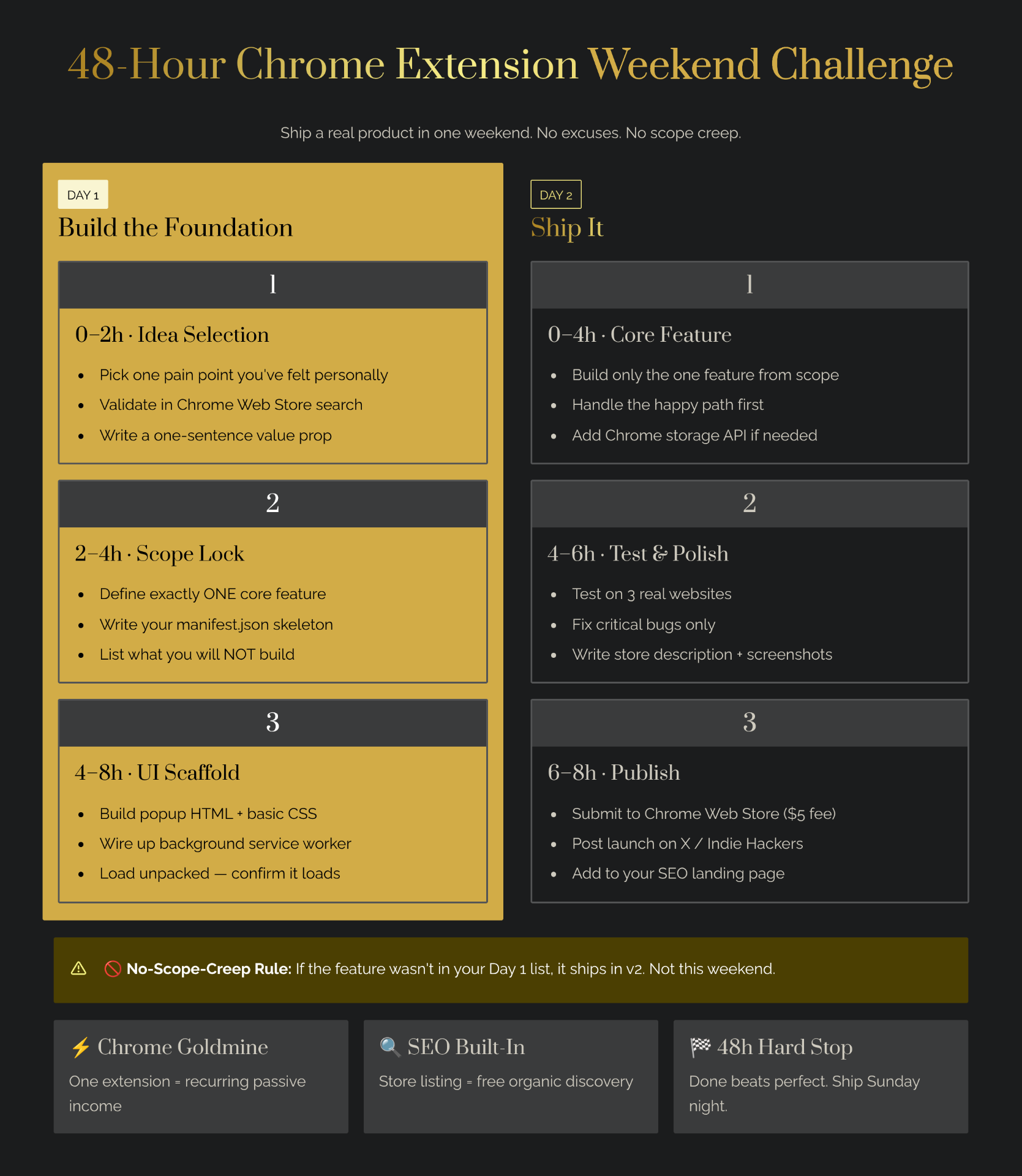
This roadmap is designed to take you from idea to first dollar in a single weekend. It's an intense sprint, but it's also a proven path to building a profitable Chrome extension.
| Time Block | Saturday | Sunday |
|---|---|---|
| Morning (9am-12pm) | Hour 0-3: Research & Selection | Hour 24-27: Monetization & Launch Prep |
| Afternoon (1pm-5pm) | Hour 4-8: MVP Development | Hour 28-32: Final Testing & Polish |
| Evening (6pm-10pm) | Hour 9-13: Core Feature Implementation | Hour 33-37: Launch & Promotion |
Hour 0–2 (Saturday Morning): Research & Selection
Most indie makers waste their entire Saturday here. You won't. With Chrome Goldmine's structured data, you can filter by category (productivity, content, social), sort by historical install counts, and read actual user reviews from when extensions were live. Pick one extension, export the details, and move on. Time saved: 3+ hours. To systematically evaluate multiple candidates before committing, set up a Deal Flow CRM for Chrome extensions in Notion.
What Makes a Chrome Extension Profitable in 48 Hours?
It's not about building a complex product; it's about solving a specific problem for a specific audience. The most successful weekend projects are the ones that focus on a single, high-value feature. Just look at the success of blurweb.app, a simple video blurring extension that was built by a solo developer and now earns over $1,000 a month. Or consider RatePunk, a hotel price comparison tool that hit $600K a year after a quick launch. These extensions are successful because they do one thing, and they do it well.
Weekend Project Failures I've Seen (and How to Avoid Them)
Not every weekend project is a success. In fact, most of them fail. But that's okay. The goal of this challenge is not to build a unicorn; it's to learn how to build and launch a product in a single weekend. The most common reason for failure is a lack of focus. It's easy to get bogged down in unnecessary features and to lose sight of the core problem you're trying to solve. The key is to be ruthless in your prioritization and to focus on the one feature that will provide the most value to your users. If you're using AI tools to build, watch out for these common vibe coding mistakes that can derail a weekend sprint.
Another common pitfall is to neglect marketing. You can build the best product in the world, but if nobody knows about it, you won't make a single sale. It's important to have a launch plan in place before you even start building. This could be as simple as posting on Reddit, sharing on Twitter, or launching on Product Hunt. Want to automate the idea-hunting step entirely? Our guide to building an AI agent for Chrome extension ideas can do the research while you sleep.
Your First Dollar: What to Expect and How to Get There
There are a number of ways to monetize your Chrome extension, from one-time payments to subscriptions. For a weekend project, the simplest approach is to charge a one-time fee for a lifetime license. This is easy to set up with a platform like Gumroad or LemonSqueezy, and it's a great way to generate your first dollar of revenue. If you want an all-in-one solution that handles not just payments but also authentication, CRM, email marketing, and membership management in a single platform, Outseta is the better option — it eliminates the need to stitch together multiple tools and lets you manage billing, customer accounts, and communication from one dashboard.
Weekend Challenge ROI: Is It Worth Your Time?
| Time Investment (hours) | Monetary Investment ($) | Expected Outcome (range) | Assumptions |
|---|---|---|---|
| 48 hours | $5 - $25 | $50 - $500 in first month | Based on a simple, niche extension with a clear value proposition and a solid launch plan. |
The biggest variable in this calculation? Validation speed. Extensions built on validated ideas convert 3–5x better than random projects. That's why 47% of Chrome Goldmine users make their first dollar within 14 days—the database front-loads the validation work so you can focus on shipping. Want to model your weekend project's upside? Our Chrome extension revenue calculator turns those user, price, and conversion assumptions into a concrete MRR projection.
Assumptions: These estimates are based on data from Indie Hackers and Product Hunt case studies (2021-2024). These numbers are estimates; real outcomes vary.
Conclusion: Your First Dollar is Just a Weekend Away
Now that you understand the weekend challenge roadmap, you have a choice: spend Saturday manually hunting for extension ideas through Reddit threads and Chrome Web Store archives—or grab Chrome Goldmine, filter for high-potential opportunities in 10 minutes, and use those saved hours to actually build. The database includes category tags, historical metrics, and user review sentiment analysis for 9,656+ expired extensions. It's the difference between wasting your weekend on research and making your first dollar by Sunday night. Want to go deeper before you build? Our reverse engineering framework shows you how to deconstruct what makes top extensions successful — so you can apply those patterns to your own weekend build. Or, if you'd rather rebuild something that already had users, check out our 7-day playbook for reviving expired extensions into micro-SaaS products. For a comprehensive guide covering MV3 architecture, validation, publishing, and monetization end to end, see our Chrome Extension Development Guide 2026.
Shipping your weekend extension in more than one language? Translate your Chrome Web Store listing to unlock i18n for Web Store rankings — Spanish, Portuguese, French, German, and Japanese are the easy wins most solo makers skip.