





Productivity Extensions That Shut Down: What Happened?
Timeline and root causes behind 30+ productivity extension shutdowns in 2024-2025, plus where the orphaned users went.
Article content
Over 30 major productivity Chrome extensions shut down in 2024–2025 alone. This wasn't a series of isolated incidents; it was a mass extinction event that left millions of users searching for alternatives. This guide provides the inside story of what happened, why these extensions failed, and what it means for indie makers looking to enter the productivity space.
We will analyze the timeline of these shutdowns, examine the root causes behind them, and explore where the orphaned user bases have migrated. By understanding the history of these productivity extensions shutdown events, you can identify the opportunities they have created and learn how to avoid the pitfalls that led to their demise.
The Timeline: When Productivity Extensions Started Disappearing
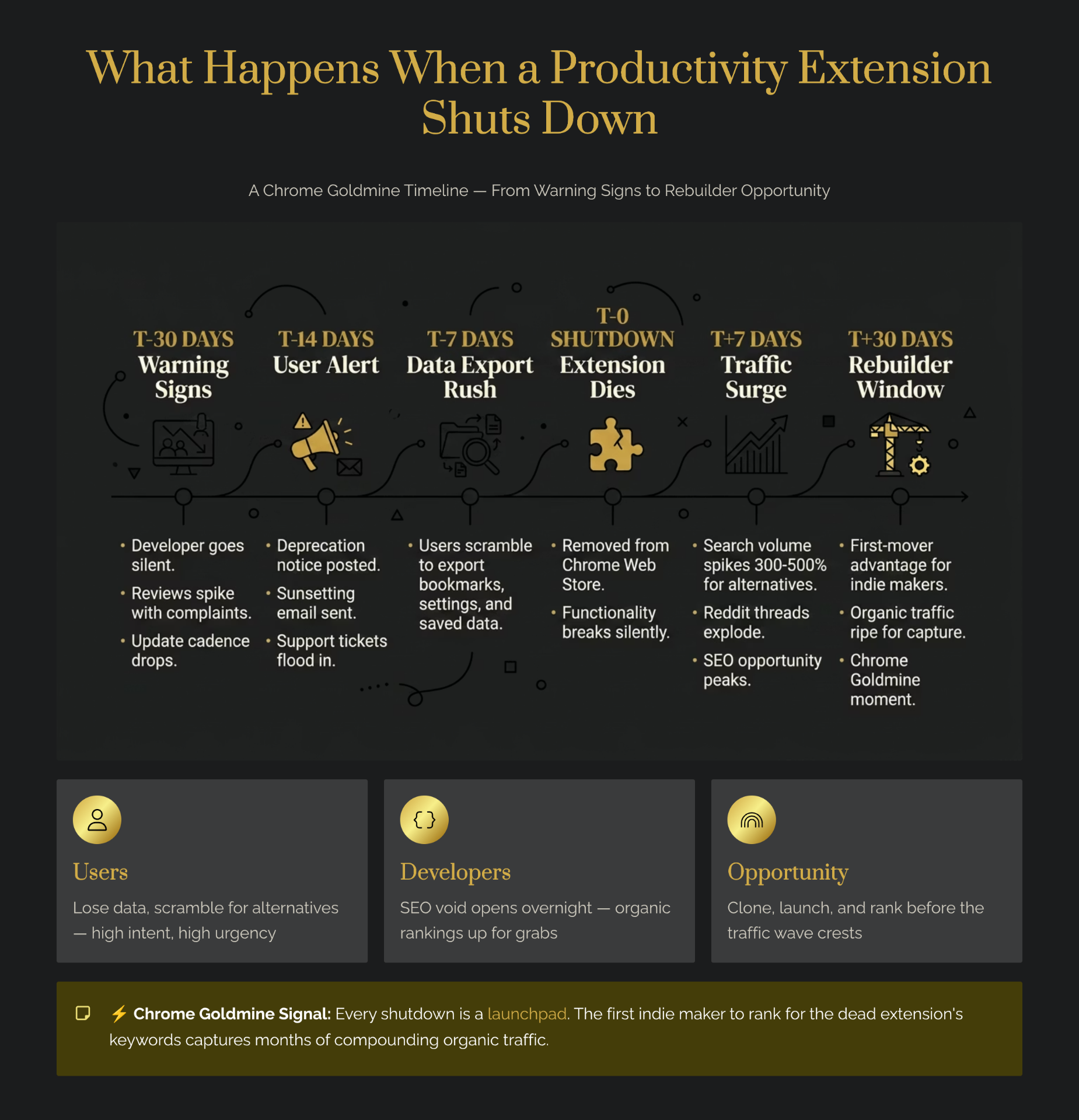
The disappearance of productivity extensions was not a sudden event, but a gradual decline that accelerated into a full-blown crisis. The timeline can be broken down into three distinct phases.
2020–2023: The Peak Era
During the COVID-19 pandemic, the world shifted to remote work, and productivity extensions experienced a golden age. With millions of people working from home, the demand for tools that could help them stay organized and focused skyrocketed. The productivity apps market grew to over $11 billion, and extensions like Todoist, Evernote Web Clipper, and Wunderlist were at the peak of their popularity.
2023–2024: Consolidation Begins
As the world began to emerge from the pandemic, the first signs of trouble appeared. In 2023, Evernote, once a dominant player in the note-taking space, began to experience significant issues with its web clipper, with many users reporting that it was no longer working with Gmail and other popular sites. This was a clear signal that the company's priorities had shifted, and the extension was no longer a focus.
2024–2026: The Mass Discontinuation
The years 2024 to 2026 marked a mass extinction event for productivity extensions. The primary driver of this was Google's mandatory transition to Manifest V3, a new platform for Chrome extensions that rendered thousands of older extensions obsolete. Developers who did not have the time or resources to migrate their extensions to the new platform were forced to shut them down. This, combined with the ongoing trend of market consolidation and the shift to mobile-first strategies, created a perfect storm that wiped out a significant portion of the productivity extension ecosystem. Our 2026 market analysis provides the full data on this discontinuation wave.
Major Productivity Extension Shutdowns (Case Studies)
To understand the forces that drove this mass extinction event, it is helpful to examine the specific cases of some of the most popular productivity extensions that were shut down. For a head-to-head comparison of the survivors and the fallen, read our Todoist vs. the Productivity Graveyard analysis.
Wunderlist: The Fallen Giant
Wunderlist was once the undisputed king of to-do list apps, with millions of loyal users who loved its simple, elegant interface. In 2015, it was acquired by Microsoft, which announced in 2019 that it would be shutting down the service on May 6, 2020, to push users to its own to-do list app, Microsoft To Do. The move was met with widespread outrage from users, many of whom felt that Microsoft To Do was a poor substitute for their beloved Wunderlist.
Evernote Web Clipper: The Neglected Tool
The Evernote Web Clipper was once an essential tool for anyone who wanted to save articles, notes, and other content from the web. However, in recent years, its functionality has degraded significantly, with many users reporting that it no longer works with Gmail and other popular sites. This is a classic case of a company neglecting a once-popular product as its strategic priorities shift.
Manifest V2 Casualties: A Mass Extinction
The mandatory transition to Manifest V3 was the final nail in the coffin for thousands of productivity extensions. Developers who did not have the time or resources to migrate their extensions to the new platform were forced to shut them down. This included popular extensions like Decreased Productivity and Autoplay Stopper, which had thousands of users but were not generating enough revenue to justify the cost of a complete rewrite.
| Extension | Shutdown Date | Reason for Shutdown | User Impact |
|---|---|---|---|
| Wunderlist | May 6, 2020 | Acquired and shut down by Microsoft | Millions of users forced to migrate |
| Evernote Web Clipper | N/A (degraded) | Neglect, lack of maintenance | Millions of users with a broken tool |
| Decreased Productivity | ~March 2025 | Manifest V3 transition | Thousands of users left without an alternative |
| Autoplay Stopper | March 2025 | Manifest V3 transition | Thousands of users left without an alternative |
Why Productivity Extensions Failed (The Root Causes)
The demise of so many productivity extensions can be attributed to four main root causes. Understanding these patterns can help you identify opportunities across all extension categories—see our best expired extensions by category guide for the full breakdown.
Mobile-First Shift
The world has gone mobile, and the productivity market is no exception. The productivity apps market is projected to reach $18.09 billion by 2030, with most of that growth coming from mobile and web apps. For many companies, browser extensions have become a lower priority, as they are seen as a niche product with a limited user base. This is why companies like Todoist have shifted their focus to their mobile and web apps, while their browser extension has become a secondary priority.
SaaS Consolidation
The productivity market has become increasingly consolidated, with a few large players like Notion, Asana, and Monday.com dominating the space. These companies have invested heavily in their web apps, which offer a more robust and feature-rich experience than a browser extension can provide. For these companies, a browser extension is a nice-to-have, but not a core part of their strategy.
Maintenance Burden
Browser extensions are not a "set it and forget it" product. They require constant maintenance to keep up with changes to the Chrome API, security patches, and compliance requirements. This can be a significant burden for small developers or companies with limited resources. The opportunity cost of maintaining an extension can be high, as that time and money could be better spent on developing the core mobile or web app.
Monetization Challenges
Monetizing a browser extension is notoriously difficult. Users have come to expect extensions to be free, and conversion rates for paid features are often low. This makes it difficult for developers to generate enough revenue to justify the cost of maintaining and updating their extensions. Platforms like Outseta have simplified this by offering all-in-one billing, authentication, and CRM—reducing the overhead that historically made monetization impractical for solo makers. This is why so many extensions were abandoned or sold to larger companies that could afford to absorb the cost. For proven strategies that work, see our extension monetization guide.
The Market Response: Where Productivity Users Migrated
The shutdown of so many productivity extensions created a vacuum in the market, and users were forced to find new solutions. The market responded in a number of ways.
Web Apps
Many users migrated to web-based productivity tools like Notion, Airtable, and the web version of Todoist. These platforms offer a more comprehensive and feature-rich experience than a browser extension can provide, and they have the advantage of being accessible from any device with a web browser.
Mobile Apps
The shift to mobile has been a major trend in the productivity market for years, and the shutdown of so many browser extensions only accelerated this trend. Users have flocked to native mobile apps on iOS and Android, which offer a superior user experience and features like push notifications that are not available in a browser extension.
AI Tools
The rise of AI has created a new category of productivity tools that are challenging the traditional to-do list and note-taking apps. Tools like ChatGPT and Claude can be used to organize tasks, summarize notes, and even generate content. These tools are still in their early days, but they have the potential to disrupt the productivity market in a major way.
Orphaned User Bases
Despite the proliferation of new tools, there are still millions of users who have been left behind by the shutdown of their favorite productivity extensions. These users are actively looking for alternatives, and they represent a massive opportunity for indie makers who can build a better solution that meets their needs. To automate your search for orphaned user bases, learn how to build an AI agent for Chrome extension ideas.
Lessons for Indie Makers
The history of productivity extension shutdowns provides a number of valuable lessons for indie makers who are considering entering this market.
Why This Is an Opportunity
The shutdown of so many extensions has created a massive opportunity for those who are willing to do the work. There are millions of users with unmet needs, and the platform consolidation has created gaps in the market that a savvy indie maker can exploit. The competition in the extension space is now lower than it has been in years, and there is a real opportunity to build a profitable business. Browse the Chrome Goldmine database to find orphaned user bases in the productivity space.
How to Avoid Becoming Another Shutdown
To avoid the fate of so many other productivity extensions, you need to learn from their mistakes. Build with maintainability in mind, and don't rely on a browser extension as your only platform. Plan for mobile and web expansion early, and diversify your monetization strategy. Keep your burn rate low with affordable tools—MailerLite for email marketing has a generous free tier. Make sure that the maintenance cost of your extension is sustainable. Most importantly, validate your idea before investing significant development time.
Differentiation Strategies
Don't just build a clone of a dead extension. To succeed, you need to find a specific use case or workflow that is not being served by the current market leaders. Consider focusing on a niche vertical, such as legal productivity or creative productivity. Build for power users who are willing to pay for a premium product, and focus on creating a unique and valuable experience that can't be easily replicated.
Opportunities from Productivity Extension Graveyards
The graveyard of dead productivity extensions is not just a cautionary tale; it is also a treasure map that can lead you to your next profitable idea.
Underserved User Segments
The shutdown of so many extensions has left a number of user segments underserved. Power users with complex workflows, specific professions like lawyers and designers, and teams that need simple group task management are all looking for better solutions. By focusing on one of these niches, you can build a product that is highly valued and has a clear path to monetization.
Specific Use Cases
Instead of building a generic to-do list app, consider focusing on a specific use case. Recurring routine management, documentation and task connection, email-to-task workflows, and voice capture are all areas where there is a real need for better solutions. By focusing on a specific use case, you can build a product that is more focused and valuable than a generic to-do list app. Use our guide on finding expired extension ideas to discover these niches systematically.
Revenue Models That Could Have Worked
Many of the extensions that failed did so because they did not have a viable monetization strategy. To succeed, you need to think about monetization from day one. A freemium model with premium workflows for power users, a B2B focus with per-seat pricing, or an enterprise tier with integrations and reporting are all viable options. You could also consider affiliate revenue by integrating with other tools and services. Pressure-test each model with our Chrome extension revenue calculator to see which pricing tier and conversion rate actually clears your maintenance costs. Our decision framework can help you evaluate which revenue model fits your extension best.
What Doesn't Work (Pitfalls to Avoid)
While the opportunities are real, there are also a number of pitfalls that you need to avoid.
Chasing Generic Productivity
The market for generic productivity tools is saturated. It is dominated by large, well-funded companies like Notion, TickTick, and Todoist, and it is very difficult to differentiate on basic to-do list features. To succeed, you need to focus on a niche or a specific workflow.
Building Without a Retention Strategy
Browser extensions are easy to uninstall, so you need to have a clear retention strategy from day one. You need to provide a high level of engagement and a clear value proposition that will keep users coming back. You can't rely on habit alone; you need to build a product that is truly indispensable.
Ignoring Platform Shifts
The world is moving to mobile, and if you build a browser extension, you need to have a plan for how you will expand to mobile and web. An extension-only strategy is a recipe for failure in the long run. Consider building a bundled product that includes an extension and a companion web app.
Conclusion: A New Era for Productivity Extensions
The mass extinction event of 2024–2026 was a painful but necessary correction for the productivity extension market. The days of a thousand nearly identical to-do list extensions are over. The future of productivity extensions belongs to those who can find a niche, solve a real problem, and build a product that is not just a tool, but a true partner in productivity.
Ready to find your own opportunity in the productivity extension graveyard? Our Complete Guide to Expired Chrome Extensions provides a step-by-step framework for finding, validating, and building your own profitable extension. Also see our Email Extensions analysis for a similar market.