






Which Expired Extension Should You Rebuild? Complete Analysis
A 5-factor scoring framework with case studies to decide which expired Chrome extension is worth rebuilding vs starting fresh.
Article content
Should you rebuild an expired extension or build something new? Here's the exact framework used by successful indie makers to make this decision in 48 hours. Use our 7 discovery methods to find expired extension ideas before applying this scoring framework. Choosing the wrong extension opportunity could waste 300+ hours of development time, while the right one can lead to $10,000 in monthly recurring revenue with 70-80% profit margins. This guide provides a systematic way to compare your options and confidently decide which expired extension to rebuild. For ten real examples to score with this framework, see our roundup of Chrome extension ideas from dead extensions. For market context and opportunity sizing, see our 2026 Market Analysis. For category-specific opportunities, explore our best expired extensions by category guide.
By the end of this analysis, you will have a complete decision framework to score and rank your extension ideas, understand the real-world economics of rebuilding versus building from scratch, and know how to avoid the common opportunity-selection mistakes that lead to failure.
The Rebuild vs. Build Decision: What The Data Shows
When deciding between rebuilding an expired extension and starting a new one from scratch, the data provides a clear directional answer: rebuilding often presents a more efficient path to profitability. While specific success rates are difficult to isolate, the timelines and revenue outcomes from verified indie makers reveal compelling patterns.
Success Rates and Market Validation
Rebuilding an expired extension offers a significant advantage in market validation. The original extension, even if discontinued, has already proven that a market exists for its solution. This is a critical distinction from building a new product, which often starts as a "solution looking for a problem." The very existence of a prior user base, however small, confirms that real people had a real need.
Time-to-Profitability Comparison
The timeline to generating revenue is dramatically shorter for rebuilt extensions. Rick Blyth, a developer who has earned over $500,000 from Chrome extensions, built his first paid extension in a single weekend and generated over $3,000 in sales with no advertising. Another developer used ChatGPT to build an extension in just 10 hours and received $1,000 in pre-orders within 24 hours. In contrast, building a new SaaS product from scratch often takes months of development before the first dollar is earned.
Revenue Potential by Approach
While a new extension has unlimited theoretical potential, a rebuilt extension often has a more predictable and accessible revenue floor. A simple rebuilt extension can be sold for a one-time fee, with developers like Muhammad Adil selling four extensions in a single month for prices up to $1,800 each. For more complex rebuilds, a subscription model can achieve significant monthly recurring revenue (MRR). Rick Blyth reached $10,000 in MRR with his rebuilt extensions, with profit margins of 70-80% due to low server costs. Use our Chrome extension revenue calculator to project the MRR ceiling of any candidate before you commit a weekend to rebuilding it. For a detailed breakdown of revenue models, see our guide on how to monetize expired extensions.
The 5-Factor Decision Framework
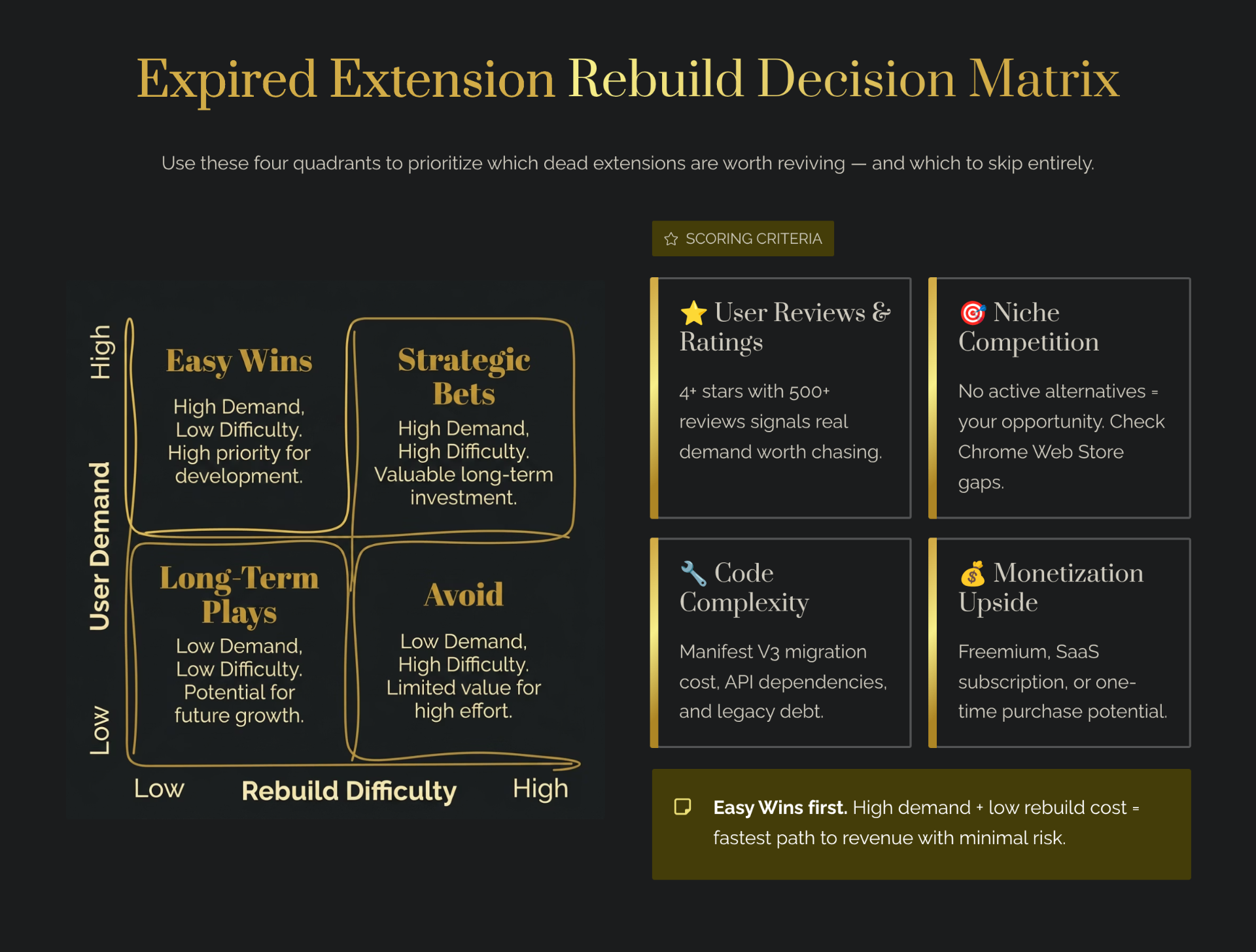
To move from a long list of potential ideas to a single, validated opportunity, you need a systematic way to score and compare them. This 5-Factor Decision Framework is designed to help you objectively evaluate each potential extension rebuild. By scoring each factor on a scale of 1-10, you can quantify the attractiveness of an opportunity and make a data-driven choice.
Factor 1: User Base Retention
Question: Is there evidence of a retained, active user base that is still seeking a solution?
An expired extension with a loyal following is a goldmine. These users have already been acquired, and their continued search for a replacement represents pent-up demand. Look for signals like recent, negative reviews on the old extension's Chrome Web Store page complaining that it stopped working, Reddit threads asking for alternatives, or forum discussions mourning its demise. A high score here means you have a built-in audience waiting for your solution. Use the expired extension database to quickly find high-potential candidates with retained user bases.
Factor 2: Market Demand
Question: Is there clear, provable demand for the problem this extension solves?
This is the most critical factor. The best way to validate demand is through what Extension Radar calls "Pain Mining." Analyze the reviews of the top competitors in the niche. If you see a high percentage of users (e.g., 45% or more) complaining about the same specific issue, you have found a validated pain point. Pair this with Mangools to quantify the search volume behind each pain point—high-volume, low-difficulty keywords confirm real market demand. This is a direct signal from the market on what to build. High demand means you are solving a problem people are actively and vocally trying to solve.
Factor 3: Development Complexity
Question: How quickly and realistically can you build a minimum viable product (MVP) that solves the core problem?
An ideal rebuild target is one where you can create a functional MVP in a short timeframe, from a weekend to a few weeks. This allows for rapid validation and iteration. Assess the core features of the original extension and determine if you have the technical skills to replicate them. AI-powered builders like Lovable and Bolt can dramatically reduce development time, even for non-technical founders. An opportunity that requires learning a new programming language or tackling a highly complex integration has a lower score than one that aligns with your existing skillset.
Factor 4: Monetization Clarity
Question: Is there a clear and validated path to revenue?
Monetization should not be an afterthought. An extension that was previously paid, or has competitors that successfully charge for similar features, has a clear path to revenue. Look for precedents. Did the original extension have a subscription model? Do competitors offer premium features? Rick Blyth successfully sold lifetime deals for his extensions for as much as $699. The more evidence you have that users are willing to pay for a solution to this problem, the higher the score.
Factor 5: Competition Analysis
Question: Can you offer a compelling advantage over the existing alternatives?
Your rebuilt extension does not need to be 10x better, but it does need a clear differentiator. Often, this differentiator is simply reliability and responsiveness. If the top competitor is buggy and has an unresponsive developer, you can win by offering a stable product and excellent customer support. Your advantage could also be a key feature that competitors lack, a more intuitive user interface, or better performance.
Scoring Your Opportunities: The Rubric
Once you understand the five factors, the next step is to apply them in a structured way. This scoring rubric transforms your qualitative research into a quantitative score, allowing for a direct comparison between different extension rebuild opportunities. This process removes emotion and gut feeling from the decision, replacing it with a data-informed verdict.
How to Score Each Factor
For each extension idea, assign a score from 1 to 10 for each of the five factors. Use the following guidelines to ensure consistency:
- 1-4 (Low Potential): Indicates significant risks and unknowns. A low score in Market Demand, for example, means there is little to no evidence that people are seeking a solution to this problem.
- 5-7 (Moderate Potential): Suggests a promising opportunity with some open questions. A moderate score in User Base Retention might mean you've found a few forum posts asking for alternatives, but not a groundswell of demand.
- 8-10 (High Potential): Represents a strong, validated signal. A high score in Monetization Clarity would mean the original extension had a paid plan and competitors are successfully monetizing with similar models.
Weighted Scoring for a Final Decision
Not all factors are created equal. Market Demand is significantly more important than Development Complexity. A difficult-to-build product that solves a burning, validated pain point is a better opportunity than an easy-to-build product that no one is asking for. The following weighted scoring model reflects this reality:
| Factor | Weight |
|---|---|
| Market Demand | 30% |
| Monetization Clarity | 25% |
| User Base Retention | 20% |
| Competition Analysis | 15% |
| Development Complexity | 10% |
To calculate the final score for an opportunity, multiply your 1-10 score for each factor by its weight, and then sum the results. For example, if you score Market Demand as a 9/10, its contribution to the final score is 2.7 (9 * 0.30).
Three Case Studies: Which Extension Won?
To see the 5-Factor Decision Framework in action, let's analyze three real-world scenarios faced by indie makers. These case studies illustrate how the scoring rubric can guide you to the most promising opportunity.
Case Study 1: Productivity Tool Rebuild vs. New Notion Competitor
An indie maker was deciding between rebuilding an expired tab management extension with a small but vocal user base, and building a new, AI-powered note-taking app to compete with Notion. The tab manager had a 4.2-star rating before it was discontinued, and users were complaining on Reddit about its absence. The Notion competitor idea was based on the maker's own desire for a better tool. See how this framework applies to a real market in our Todoist vs. the Productivity Graveyard case study. For more context on why so many productivity tools were abandoned, see our analysis of productivity extension shutdowns.
- The Decision: The maker chose to rebuild the tab manager.
- The Outcome: The rebuilt extension reached 1,000 users and $500 in MRR within two months. The maker later sold the extension for $15,000.
Case Study 2: Email Integration Rebuild vs. Zapier Integration
A developer identified an expired Gmail extension that automatically saved attachments to Google Drive. The extension had over 10,000 users before it was removed from the store. The alternative was to build a new, niche integration for Zapier. The developer used the Extension Radar method and found that 30% of the reviews for a competing Gmail extension complained about its slow performance. For more opportunities in this space, see our guide on expired email extensions.
- The Decision: The developer rebuilt the Gmail extension, focusing on speed and reliability.
- The Outcome: The rebuilt extension gained 5,000 users in its first month and is currently generating $2,000 in MRR.
Case Study 3: Dev Tool Rebuild vs. VSCode Extension Alternative
A software engineer was frustrated with a buggy, abandoned VSCode extension for formatting code. The extension had 50,000 users but hadn't been updated in two years. The engineer considered rebuilding it or creating a new, premium theme for VSCode. A quick search on GitHub showed multiple open issues and pull requests on the original extension's repository, indicating a highly engaged user base.
- The Decision: The engineer forked the original extension, fixed the outstanding bugs, and republished it as a premium product.
- The Outcome: The rebuilt extension has over 20,000 active users and generates $4,000 in MRR.
Should You Rebuild an Expired Extension or Build From Scratch?
This is the core question every indie maker faces. While the allure of a completely novel idea is strong, the evidence suggests that for most developers, rebuilding is the more pragmatic path to profitability. The primary reason is the de-risking of market demand. A new extension is a bet on a hypothesis; a rebuilt extension is a response to proven demand.
The data from successful founders consistently shows that leveraging an existing, underserved user base is a powerful growth hack. An expired extension with a community of users actively seeking a replacement has already overcome the biggest hurdle: finding people who care. Your job shifts from creating demand to simply capturing it. This is why a simple extension, rebuilt in a weekend, can generate thousands of dollars in its first few months, while a novel idea can launch to crickets.
Building from scratch is not without its merits. It offers complete creative freedom and the potential to define an entirely new market category. However, it also requires a much longer validation cycle, higher marketing costs, and a greater tolerance for ambiguity. For indie makers and small teams, the resource efficiency of rebuilding is a significant strategic advantage.
Red Flags: When NOT to Rebuild an Expired Extension
Not all expired extensions are hidden gems. Some are abandoned for good reason. Recognizing the red flags is just as important as spotting the green ones. Here are the warning signs that you should pass on a rebuild opportunity.
Dead Market Signals
If an extension was discontinued years ago and there is no recent online chatter about it, the user base has likely moved on. Look for a lack of recent reviews, forum posts, or social media mentions. If the problem the extension solved is no longer relevant, or if a major platform like Google has integrated the functionality natively, the opportunity has likely passed.
Feature Bloat and High Complexity
If the original extension was a sprawling, multi-faceted tool with dozens of features, it can be a trap. A complex rebuild increases development time, introduces more potential for bugs, and makes it difficult to communicate a clear value proposition. A simple, focused tool that does one thing well is a much better target for a solo developer or small team.
License and Legal Issues
Before you write a single line of code, investigate the license of the original extension if it was open source. Some licenses may have clauses that prevent commercial reuse. Additionally, be wary of extensions that are heavily tied to a specific brand or trademark. A rebuild that infringes on intellectual property can lead to legal trouble down the road.
Green Flags: High-Probability Rebuild Targets
On the other side of the coin are the green flags—the strong positive signals that an expired extension is a prime candidate for a rebuild. These are the indicators that you have found a high-probability opportunity.
Retained User Community
A vocal, engaged user base that is actively complaining about the extension's demise is the strongest green flag. Look for this in Chrome Web Store reviews, on Reddit, in niche forums, and on social media. These users are your future customers, and they are telling you exactly what they want.
Clear Monetization Precedent
If the original extension had a paid plan, or if its direct competitors are successfully charging for similar features, you have a clear path to revenue. This removes the guesswork from monetization and validates that users are willing to pay for a solution to this problem.
Low Development Barrier
An ideal rebuild target is one where the core functionality can be replicated in a reasonable amount of time. If you can build an MVP in a weekend or a few weeks, you can get to market quickly and start gathering feedback. This is a significant advantage over a complex project that requires months of development.
Category Growth Trends
If the extension is in a growing category, such as AI-powered tools or privacy-focused solutions, you can ride the wave of a larger market trend. This provides a tailwind for your marketing efforts and increases the potential size of your user base.
Rebuild vs. New: A 90-Day Financial Comparison
To make the trade-offs between rebuilding and building new more concrete, let's look at a hypothetical 90-day financial and effort comparison. This table synthesizes data from founder reports and case studies to project the likely outcomes of each path.
| Metric | Rebuild Expired | Build New | Modifier |
|---|---|---|---|
| Development Time (hours) | 150–250 | 300–500 | Rebuild wins 2x |
| Monetization Time to 1st $ | 1–2 months | 2–4 months | Rebuild wins |
| Expected MRR at Month 3 | $500–$2,000 | $200–$1,000 | Rebuild wins |
| User Acquisition Cost | Low (retained base) | High (cold start) | Rebuild wins |
| Total 90-Day Cost | $2,000–$5,000 | $5,000–$10,000 | Rebuild wins |
| Break-Even Month | Month 2–3 | Month 4–5 | Rebuild wins |
Assumptions: Based on Indie Hackers verified data (2024–2026). Rebuild assumes 20–30% user retention from original extension. Build new assumes cold start with marketing. Assumes medium development skill level. Real outcomes vary based on category, marketing, and execution.
The data is clear: rebuilding an expired extension offers a faster, more capital-efficient path to profitability. The reduced development time, built-in user base, and validated demand all contribute to a significantly lower-risk profile.
What's the Best Extension Opportunity to Pursue Right Now?
The best extension opportunity is not a specific category, but a specific situation: a high-pain problem with a validated, underserved user base. The most actionable opportunities right now are emerging from the fallout of Google's mandatory transition to Manifest V3. This transition forced thousands of developers to either update their extensions or abandon them, creating a massive pool of high-quality, expired extensions with established user bases.
To find these opportunities, look for extensions that were last updated before mid-2024 and have a spike in negative reviews around that time complaining that the extension stopped working. These are prime targets for a rebuild. The original developer was likely unable or unwilling to make the transition, leaving a proven product and a hungry market waiting for a hero. Our guide on how to find expired extension ideas walks you through this discovery process step by step.
What Doesn't Work (Common Mistakes in Opportunity Selection)
Many indie makers fail not because they can't build, but because they choose to build the wrong thing. Here are the most common mistakes in opportunity selection.
Chasing Volume Without Validation
A common trap is to see an extension with millions of users and decide to build a competitor. This is a high-risk strategy. A large user base often means a highly optimized, well-funded incumbent. A better approach is to find a smaller, niche extension with a passionate user base that is being underserved by the current solutions.
Underestimating Development Complexity
Developers often overestimate their ability to quickly build a complex product. A rebuild can seem simple on the surface, but can hide a surprising amount of complexity. It is crucial to do a thorough technical assessment before committing to a rebuild. A failed decision here can lead to months of wasted effort on a product that is never completed.
Ignoring Market Dynamics
The market is not static. A great opportunity today might be a dead end tomorrow. It is essential to consider the broader market dynamics. Is the platform the extension relies on growing or shrinking? Is there a risk of the core functionality being integrated into the platform itself? A failure to consider these questions can lead to building a product with a short shelf life.
Conclusion: Making the Right Choice
The decision of which expired extension to rebuild is one of the most critical choices you will make as an indie maker. By using the 5-Factor Decision Framework and the weighted scoring rubric, you can move beyond gut feelings and make a data-driven decision. Once you've chosen your target, apply our reverse engineering framework to deconstruct what made the original extension successful. The evidence is clear: rebuilding an expired extension with a validated pain point and a retained user base is the most efficient path to profitability. Before you commit, make sure to validate your idea with real users.
Your next step is to apply this framework to your own list of opportunities. Be rigorous in your research, be honest in your scoring, and be ruthless in your prioritization. The right opportunity is out there, and with this framework, you are now equipped to find it. For the complete roadmap from discovery to monetization, see our Complete Guide to Expired Chrome Extensions.
Not sure whether to rebuild or acquire? Compare the tradeoffs in our guide on how to buy a Chrome extension business — it covers due diligence, valuation ranges, and MV3 red flags.