





Top Expired Extensions: Todoist vs. The Productivity Graveyard
Why Todoist survived while Wunderlist and Evernote Web Clipper died, and where the rebuild opportunities remain in 2026.

Article content
Todoist once dominated the productivity space as a beloved Chrome extension. While many believe it has been discontinued, the truth is more complex: the extension is still active, boasting over 700,000 users and a 4.7-star rating. However, the landscape around it is a graveyard of failed and abandoned productivity extensions, including giants like Wunderlist and the once-mighty Evernote Web Clipper. This creates a unique opportunity for indie makers looking for an expired Todoist alternative to rebuild. For a broader look at the productivity market, see our Productivity Extensions Shutdown analysis.
This guide provides a complete breakdown of the productivity extension market. We will analyze why the Todoist extension survived while its competitors failed, identify the market gaps left by discontinued tools, and assess the revenue potential for rebuilding in this lucrative niche. By the end, you will have a clear understanding of whether the productivity space is a viable market for your next extension project. Once you've identified an opportunity, learn how to monetize it effectively.
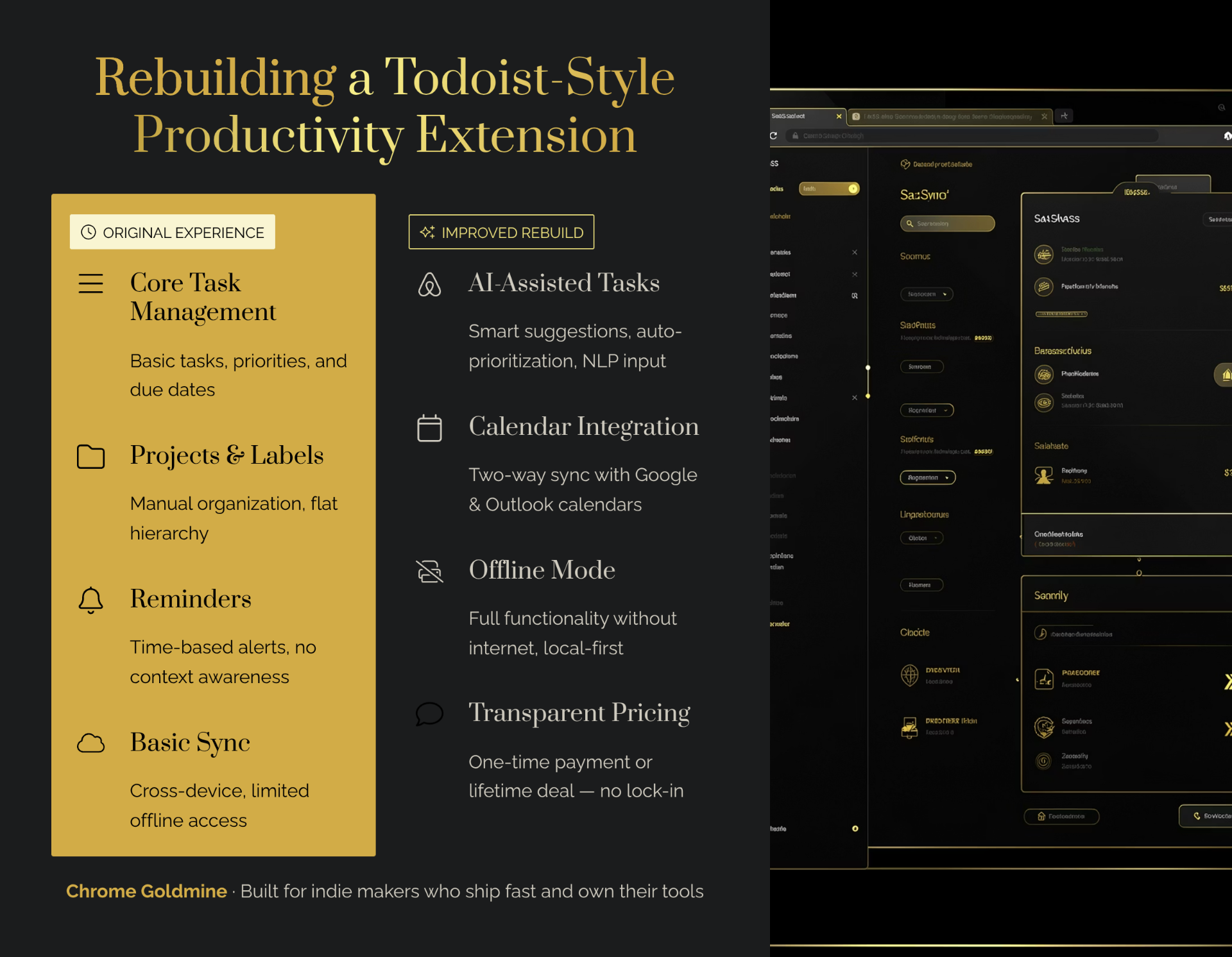
Why Productivity Extensions Get Discontinued
The productivity extension market is a brutal landscape. For every success story like Todoist, there are dozens of failures. Understanding why these extensions get discontinued is the first step to identifying a viable opportunity.
Market Consolidation and Strategy Shifts
The most common reason for the demise of a popular productivity extension is a strategic shift by the parent company. Wunderlist, once a beloved to-do list app with millions of users, was acquired by Microsoft in 2015 and officially shut down on May 6, 2020, to push users toward Microsoft To Do. This is a classic example of market consolidation, where a larger player acquires a competitor to eliminate it and absorb its user base.
Similarly, many companies have shifted to a mobile-first or web-app-first strategy, causing their browser extensions to become a lower priority. The maintenance burden of a Chrome extension, especially with major platform changes like the transition to Manifest V3, can be difficult to justify for a feature that is not core to the company's strategy.
User Migration Patterns
When a popular extension is discontinued, its users are forced to find alternatives. In the case of Wunderlist, many users were pushed to Microsoft To Do, but a significant portion were unhappy with the replacement and actively sought out other options. This creates a large, motivated pool of users who are actively looking for a new solution. These are not just casual browsers; they are experienced users who know what they want and are willing to pay for it.
The Manifest V3 Extinction Event
The mandatory transition to Manifest V3 has been a mass extinction event for Chrome extensions. Thousands of extensions, including many in the productivity space, were rendered obsolete overnight because their developers did not have the time or resources to migrate them to the new platform. This has created a massive, time-sensitive opportunity for developers who can rebuild these abandoned extensions on the new platform. Our 2026 market analysis quantifies the full scope of this MV3-driven opportunity.
The Productivity Extension Market in 2026
The productivity app market is a massive and growing industry. In 2025, the market was valued at $11.96 billion and is projected to reach $18.09 billion by 2030, with a compound annual growth rate (CAGR) of 8.63%. The to-do list app market, a subset of the broader productivity market, was valued at $1.43 billion in 2025 and is projected to reach $3.66 billion by 2035. This indicates a healthy and expanding ecosystem with significant commercial potential. For a complete ranking of all extension categories by revenue potential, see our best expired extensions by category 2026 guide.
Discontinuation Rate for Productivity Tools
While the market is growing, it is also characterized by a high rate of churn. The Manifest V3 transition has been a major driver of this, but even before that, many productivity extensions were abandoned due to a lack of resources or a shift in company strategy. This constant churn creates a steady stream of new opportunities for indie makers.
User Demand Signals
Despite the proliferation of web and mobile productivity apps, there is still strong demand for browser extensions that can provide a quick, lightweight, and context-aware way to manage tasks. A search of Reddit and Twitter reveals a constant stream of users complaining about the demise of their favorite productivity extension and asking for alternatives. This is a clear signal that there is a market for well-built, well-maintained productivity extensions.
Dead Productivity Extensions Worth Rebuilding
While Todoist has survived and thrived, the landscape is littered with the corpses of its former competitors. These dead extensions represent a treasure trove of opportunities for indie makers.
Wunderlist: The Fallen Giant
Wunderlist was once the king of to-do list apps, with millions of loyal users. Its acquisition and subsequent shutdown by Microsoft left a massive void in the market. While Microsoft To Do was positioned as the official replacement, many users found it to be a poor substitute. A rebuilt version of Wunderlist that captures the simplicity and elegance of the original could be a huge success.
Evernote Web Clipper: The Neglected Tool
The Evernote Web Clipper was once a must-have extension for anyone who wanted to save articles, notes, and other content from the web. However, in recent years, its functionality has degraded significantly, with many users reporting that it no longer works with Gmail and other popular sites. This has created an opportunity for a new web clipper that is reliable, well-maintained, and integrates with modern productivity tools.
Revenue Potential Analysis
The revenue potential for a rebuilt productivity extension is significant. Case studies from Starter Story show that productivity extensions can generate anywhere from $100,000 to over $1 million in annual revenue. Momentum, a personal dashboard extension, generates nearly $1 million per year, while GMass, an email marketing extension, brings in over $5 million annually — see our email extensions guide for a deep dive into that market. Even in the crowded to-do list market, there are examples of apps generating over $200,000 per month. Model your own productivity rebuild with our Chrome extension revenue calculator to see what your user base and pricing would realistically produce.
Competitive Landscape: Todoist Extension Alternatives
While Todoist is the dominant player in the to-do list extension market, there are a number of other productivity tools that offer browser extensions, including TickTick, Any.do, and Focus To-Do. However, many of the largest productivity platforms, such as Notion, Asana, and Monday.com, have a limited or non-existent extension presence. This is because their strategy is focused on their web and mobile apps, and the maintenance burden of a browser extension is not a priority.
Market Gaps
This creates a number of market gaps that a savvy indie maker can exploit:
- Speed and Simplicity: Many users miss the lightweight, single-purpose nature of older extensions like Wunderlist. A new extension that is fast, simple, and focused on doing one thing well could be a welcome alternative to the bloated, all-in-one productivity platforms.
- Browser Context: One of the key advantages of a browser extension is its ability to interact with the content of the current page. There is a huge opportunity for an extension that can intelligently extract context from the page and use it to create more useful tasks and notes.
- Integration with Modern Tools: Many of the older, abandoned extensions were built before the rise of modern productivity tools like Notion and Airtable. There is a significant opportunity for a new extension that can bridge the gap between these new platforms and the browser.
Building a Better Productivity Extension
To succeed in this market, you can't just clone a dead extension. You need to understand what made the original great, and then innovate on top of it.
What Made Todoist Extension Sticky
The Todoist extension has been so successful because it nails the core user needs for a browser-based task manager:
- Quick Task Capture: The ability to add a task from anywhere on the web with a single click.
- Natural Language Parsing: The ability to understand natural language due dates, such as "next Tuesday at 3pm."
- Recurring Tasks: Robust support for recurring tasks and reminders.
- Minimal UI: A clean, simple interface that doesn't get in the way.
Innovation Opportunities
While Todoist is a great product, there are still plenty of opportunities to innovate. Use our guide on finding expired extension ideas to discover specific gaps in the productivity market:
- AI-Powered Features: An extension that uses AI to suggest tasks based on your browsing history, or to automatically categorize and prioritize your to-do list.
- Team Collaboration: Most to-do list extensions are designed for individual use. There is a huge opportunity for an extension that is designed for teams, with features like shared task lists, comments, and assignments.
- Workflow Automation: An extension that can automate common workflows, such as creating a new task from a new email in Gmail, or adding a new article to your reading list when you save it to Pocket.
Monetization for Productivity Tools
The most common and effective monetization model for productivity tools is a freemium subscription. This allows you to attract a large user base with a free version of your product, and then convert a percentage of those users to a paid plan for access to premium features. Outseta handles the entire billing lifecycle—from signup to subscription management to churn prevention—so you can focus on the product. Premium features could include things like team collaboration, advanced filtering, or API access.
Productivity Extensions Comparison Table
To better understand the opportunities in this market, it is helpful to compare the historical landscape of productivity extensions with the current one.
Table 1: Historical Productivity Extensions vs. Current Landscape
| Extension | Peak Users | Discontinued | Main Feature | Why It Failed | Alternative Today |
|---|---|---|---|---|---|
| Wunderlist | Millions | 2020 | Simple, elegant to-do list | Acquired and shut down by Microsoft | Microsoft To Do (forced migration) |
| Evernote Web Clipper | Millions | N/A (degraded) | Web page clipping | Neglect, lack of maintenance | Limited native browser features |
| Decreased Productivity | Thousands | ~2025 | Unknown | Manifest V3 transition | None |
| Todoist | 700,000+ | Active | Quick task capture, NLP | N/A (survived) | Todoist web/mobile apps |
Table 2: What Users Are Missing
| Need | Discontinued Extensions | Current Alternatives | Extension Opportunity |
|---|---|---|---|
| Quick Capture | Excellent (1-click, lightweight) | Good (requires app open, can be slow) | High – Speed and convenience are key differentiators |
| Browser Context | Good (could add URL/tab title) | Limited (no direct access) | High – Huge opportunity for intelligent context extraction |
| Simplicity | Excellent (single-purpose, minimal UI) | Poor (often bloated, all-in-one platforms) | High – A return to simplicity would be a welcome change |
| Offline Access | Good (most had offline mode) | Good (most have offline mode) | Medium – Parity exists, but reliability is key |
Market Size & Revenue Potential
The productivity market is a multi-billion dollar industry, and the to-do list app segment alone is projected to reach $3.66 billion by 2035. While the market is competitive, the high rate of churn and the constant stream of new opportunities make it an attractive space for indie makers. Use the extension database to find productivity opportunities with orphaned user bases.
Average Revenue Per Productivity Extension
Based on data from Starter Story, a successful productivity extension can generate anywhere from $100,000 to over $1 million in annual revenue. Momentum, a personal dashboard extension, generates nearly $1 million per year, while GMass, an email marketing extension, brings in over $5 million annually. Even in the crowded to-do list market, there are examples of apps generating over $200,000 per month.
ROI Analysis for Rebuild
The return on investment for a rebuilt productivity extension can be significant. The startup costs are low, the profit margins are high, and the potential for a multi-six-figure exit is very real. With a clear market need, a validated idea, and a solid execution plan, a rebuilt productivity extension can be a very profitable business. Make sure to validate your idea before committing development time.
Conclusion: Is the Productivity Market Worth It?
The productivity extension market is a challenging but potentially very rewarding space for indie makers. While the market is crowded and the competition is fierce, the high rate of churn and the constant stream of new opportunities make it a viable market for those who are willing to do the work.
The key to success is to find a niche, solve a real problem, and build a product that is not just a clone of a dead extension, but an innovative improvement on it. AI builders like Lovable make it possible to ship a working MVP in a weekend, even without deep coding experience. Ready to build? Our $1,000/month side income blueprint shows how to turn a rebuilt productivity extension into a portfolio business. By understanding why extensions like Wunderlist failed and why Todoist survived, you can learn from their mistakes and build a better product. The opportunity is there for the taking.
Ready to find your own productivity extension opportunity? Our Complete Guide to Expired Chrome Extensions provides a step-by-step framework for finding, validating, and building your own profitable extension. Also check out our decision framework to evaluate your options.