







How to Monetize a Chrome Extension (2026 Guide + Revenue Data)
Learn how to monetize a Chrome extension with 5 proven models, 2026 revenue benchmarks, and real pricing data. Includes payment setup guide for indie makers.

Short answer: most paid Chrome extensions monetize through one of five models — freemium, one-time/lifetime, subscription, affiliate revenue, or sponsorships. Typical free-to-paid conversion sits around 1–5% for freemium and 0.5–2% for subscriptions, so revenue is mostly a function of install volume × conversion × price. This 2026 guide shows exactly what to charge, which model fits your extension, how to take payments inside an extension, and what realistic earnings look like — see the revenue benchmarks for the numbers, or run your own with the free Chrome extension revenue calculator.
- Which model should I pick? Start with the 5 models below, then read the freemium breakdown.
- What should I charge? See our pricing strategy guide.
- How do I accept payments? Follow the Stripe payment integration guide.
- How much can I realistically earn? Check the revenue benchmarks.
- Can I sell the extension later? Yes — see selling a Chrome extension.
Most indie makers leave $500–$3,000 on the table annually by choosing the wrong monetization model. Here's exactly how to pick the right one. You've found a promising expired Chrome extension, rebuilt it, and are ready to launch. But how do you monetize your expired Chrome extension effectively? This comprehensive guide will help you understand the five proven revenue models that actually work in 2026, learn which model best fits your extension type, and see real revenue data from successful indie makers who have generated six-figure incomes from their extensions.
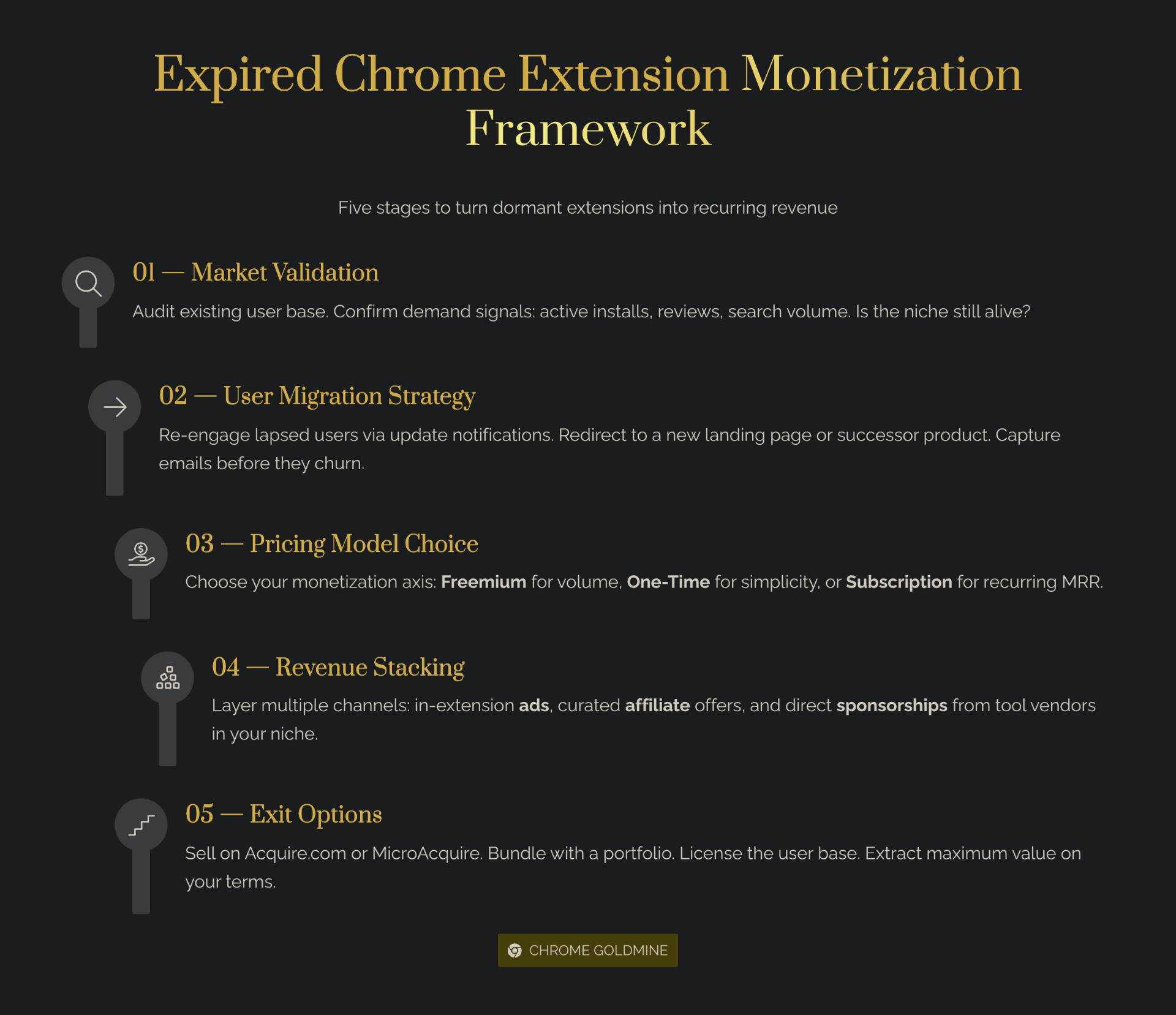
The 5 Extension Monetization Models That Actually Work
Choosing the right monetization model is critical to the success of your rebuilt extension. While there are many ways to make money, five models have proven to be the most effective for indie makers in 2026. The browser extension market reached $7.8 billion in 2024, expanding 23% year-over-year, demonstrating the significant opportunity for developers who choose the right monetization strategy. For a deep dive into the numbers, see our market analysis.
Freemium (Most Common)
The freemium model offers a basic version of your extension for free, with the option to upgrade to a premium version with additional features. This is the most popular model for indie makers because it allows you to build a large user base and then convert a percentage of those users to paying customers. The typical conversion rate for freemium extensions is between 1-5%, with some well-optimized extensions achieving conversion rates as high as 20% when offering free trials.
Premium/Lifetime
A premium or lifetime model involves charging a one-time fee for your extension. This model is best for extensions that provide a clear and immediate value proposition, such as developer tools or specialized utilities. While it can generate a significant amount of revenue upfront, it lacks the recurring revenue of a subscription model. However, the conversion rates for one-time purchases tend to be higher, typically ranging from 2-8%.
Subscription
The subscription model involves charging a recurring fee (monthly or yearly) for access to your extension. This model provides a predictable and scalable revenue stream, but it also has the lowest conversion rates, typically between 0.5-2%. Subscription models are best suited for extensions that provide ongoing value, such as productivity tools, developer utilities, or services with recurring costs like API access.
Affiliate Revenue
With the affiliate revenue model, you earn a commission by promoting other products or services within your extension. This can be a great way to generate revenue without charging your users directly. For example, a shopping extension could earn a commission on purchases made through its affiliate links. Successful e-commerce extensions can earn $5,000-$20,000 per month with this model, with affiliate commissions typically ranging from 5-15% of each sale.
In-App Advertising
In-app advertising involves displaying ads within your extension. While this can be a way to generate revenue, it is often the least effective and can lead to a poor user experience. Ad revenue is typically low, ranging from $50-$200 per month, and is only viable for extensions with a very high number of active users. Most successful indie makers avoid this model in favor of more sustainable revenue streams.
Freemium Model: The Indie Maker Default
The freemium model is the go-to strategy for many indie makers, and for good reason. It allows you to attract a large user base with a free, feature-limited version of your extension, then convert a portion of those users into paying customers for the premium version. This model is particularly effective for extensions with broad appeal, where the value of the premium features becomes apparent after regular use.
How It Works + Typical Conversion Rates
The key to a successful freemium model is to provide enough value in the free version to attract and retain users, while creating a compelling reason to upgrade. This can be achieved by limiting the number of actions a user can perform, restricting access to advanced features, or offering a more powerful version for a fee. Industry data shows that freemium conversion rates typically range from 2-5%, though some extensions achieve higher rates with optimized onboarding and clear value propositions.
Extensions with 100,000+ users can generate $10,000-$50,000+ monthly with conversion rates in the 1-5% range. The key is to ensure that your free tier provides genuine value while making the benefits of upgrading crystal clear.
Case Study: GoFullPage
A great example of a successful freemium extension is GoFullPage, a tool for taking full-page screenshots. The core functionality is free, but users can upgrade for $1/month to unlock premium features like annotations and priority support. With over 4 million users and a modest $1 monthly price point, GoFullPage generates $10,000 in monthly recurring revenue, demonstrating the power of a well-executed freemium model at scale.
Another success story comes from a task management extension that reached 200,000 users in six months. With a freemium model priced at $4.99/month for premium features, they achieved a 3% conversion rate, resulting in 6,000 paying subscribers and $30,000 in monthly recurring revenue.
Pros / Cons for Different Categories
The freemium model works exceptionally well for productivity tools because it allows users to experience the core functionality before committing to a purchase. Users can see exactly how the extension saves them time or improves their workflow, making the upgrade decision easier. Content creation tools also benefit from this approach, as users can test the basic features and then upgrade when they need more advanced capabilities.
However, the freemium model can be challenging for developer tools and niche extensions. Developer tools often require a smaller, more specialized audience, making it difficult to achieve the large user base needed for freemium to be profitable. Similarly, niche tools targeting a very specific audience may struggle to convert enough free users to make the model viable.
Subscription Model: Highest LTV, Lowest Conversion
The subscription model offers the highest lifetime value (LTV) per customer, but it also comes with the lowest conversion rates. This model is best suited for extensions that provide ongoing value and have recurring costs, such as those that rely on a server, database, or API. By charging a recurring fee, you can build a predictable and scalable revenue stream that compounds over time.
Pricing Strategy ($5–$30/mo Range)
Pricing for subscription-based extensions typically ranges from $5 to $30 per month, with the sweet spot often falling between $8 and $15 for most indie maker extensions. The right price point depends on the value your extension provides, your target audience, and the features included in your subscription plans.
For example, GMass, an email marketing extension, offers plans from $8 to $20 per month and generates over $130,000 in monthly recurring revenue with almost 10,000 subscribers. Another successful example is Closet Tools, which charges $30/month for automation features on Poshmark and generates $42,000 in monthly recurring revenue.
Retention Challenges + Mitigation
The biggest challenge with the subscription model is user churn. To mitigate this, you need to continuously provide value to your subscribers. This can be achieved through regular updates, new features, and excellent customer support. Automated email sequences via MailerLite — such as onboarding drips, usage tips, and re-engagement campaigns — are one of the most effective ways to reduce churn without manual effort. It's also important to have a clear and easy-to-use billing and subscription management system.
Platforms like Outseta (starting at $37/month with 1-2% transaction fees) and Lemon Squeezy (5% + $0.50 per transaction) can help you manage subscriptions and reduce churn by providing professional billing infrastructure. These platforms handle the technical complexity of subscription management, allowing you to focus on building features that keep users engaged.
Best For: Productivity, Dev Tools, Email
The subscription model is particularly well-suited for productivity tools that help users save time or be more efficient on a daily basis. Extensions that become part of a user's regular workflow can justify a recurring fee because the value compounds over time. Developer tools that provide ongoing value, such as code formatters, API clients, or debugging utilities, are also excellent candidates for subscription pricing. Finally, email extensions that enhance the email experience work well with subscriptions because they provide continuous value with each email sent. For more on email extension opportunities, see our guide on expired email extensions.
Premium / Lifetime Model: Best for Solo Makers?
The premium or lifetime model, where users pay a one-time fee for your extension, can be an attractive option for solo makers. It provides a simple and straightforward way to generate revenue without the complexities of managing subscriptions, handling recurring billing, or dealing with churn. This model is particularly effective for extensions that offer a clear and immediate value proposition, such as specialized utilities or developer tools.
One-Time Payment Psychology
The psychology behind a one-time payment is powerful. Users are often more willing to make a single purchase than to commit to a recurring subscription, even if the total cost is higher over time. This is because a one-time payment feels like a finite and manageable expense, while a subscription can feel like an ongoing financial commitment. This psychological advantage can lead to higher conversion rates, with some extensions seeing purchase rates of 2-8%.
For solo makers, the simplicity of a one-time payment model is appealing. You don't need to worry about subscription management, billing cycles, or retention strategies. Once a user purchases your extension, the transaction is complete, and you can focus on providing support and occasional updates rather than constantly proving ongoing value.
Case Study: CSS Scan
CSS Scan is a prime example of a successful premium extension. This developer tool, which allows users to easily inspect and copy CSS from any website, charges a one-time fee of $69. The creator, Guilherme Rizzo, has generated over $100,000 in revenue from the extension, proving that a well-crafted premium extension can be highly profitable. The extension gained significant traction on Product Hunt, receiving 754 votes in its first launch and 1,917 votes in its second launch.
Another example is Spider, a visual point-and-click web scraper that charges $38 for lifetime access. Created by Amie Chen, the extension generated $10,000 in just two months and was featured as the #1 Product of the Day on Product Hunt with 1,345 votes.
When This Outperforms Freemium
A premium model can outperform a freemium model in several scenarios. When your extension targets a niche audience, a premium model can be more profitable than trying to convert a small number of users from a free to a paid plan. If your extension provides high-value tools that deliver significant and immediate value, users are more likely to be willing to pay for it upfront. Developer tools, specialized utilities, and professional-grade extensions often fall into this category. Finally, for extensions that require low maintenance and minimal ongoing support, a one-time payment model can be a simple and effective way to generate revenue without the overhead of managing a subscription business. Not sure which type to rebuild? Our guide on which expired extensions to rebuild can help.
Affiliate + Sponsored Revenue Streams
Another powerful way to monetize your expired Chrome extension is through affiliate and sponsored revenue streams. Instead of charging users directly, you earn commissions by promoting other products or services. This model is particularly effective for extensions that enhance a user's workflow or integrate with other popular tools, creating natural opportunities for relevant recommendations.
How It Works + Risks
The affiliate model works by embedding special tracking links within your extension. When a user clicks on one of these links and makes a purchase, you receive a percentage of the sale. This can be a highly profitable model, with successful e-commerce extensions earning between $5,000 and $20,000 per month. E-commerce extensions typically earn 5-15% commission on purchases, while travel tools can earn commissions on hotel and flight bookings.
A notable example is Coupert, which operates with 8 million weekly users across 200,000 retail sites. The extension generates revenue through affiliate commissions ranging from 1-8% of sale value, combined with a data-as-a-service offering for merchants. Coupert maintains a 4.8/5.0 rating on Trustpilot and was chosen as Microsoft's official coupon provider, demonstrating that transparency and quality can coexist with affiliate monetization.
However, the affiliate model is not without risks. Your revenue is dependent on the performance of the products you promote, and you must be transparent with your users about your affiliate relationships to maintain trust. The Honey scandal of late 2024 serves as a cautionary tale about the importance of ethical affiliate practices.
Best Integrations
The most successful affiliate integrations are those that feel natural and add value to the user experience. Shopping extensions that show price comparisons can earn substantial affiliate revenue by directing users to the best deals while earning commissions on purchases. Price tracking and coupon extensions with 500,000+ active users can generate $25,000-$40,000 per month with low maintenance requirements, making this an attractive model for extensions with high user engagement. Browse our recommended tools and platforms for partnership inspiration.
What Doesn't Work (and Why)
While it's tempting to explore every possible revenue stream, some monetization models are simply not effective for Chrome extensions in 2026. Understanding what to avoid can save you time, money, and protect your user experience.
Pay-Per-Install Models (Declining)
Pay-per-install (PPI) models, where you get paid for each time your extension is installed, were once a popular way to monetize. However, this model has been in decline for years. The revenue per install is often very low, typically just a few cents, and it can incentivize developers to focus on quantity over quality. Furthermore, many ad networks that offer PPI have been banned from the Chrome Web Store for deceptive practices.
Ad-Only Models (Low Revenue, Bad UX)
Monetizing your extension solely through ads is another strategy that rarely works. The revenue generated from ads is typically very low, often just a few dollars per thousand users. More importantly, ads can significantly degrade the user experience, leading to negative reviews and uninstalls. Extensions using predictive models and sophisticated monetization strategies generate 20-30% more revenue per user than those relying solely on affiliate commissions or ads.
Honest Failure Story
Many developers have tried and failed with these models. For example, one indie hacker reported having over 70,000 users on their Chrome extension but making almost no revenue from an ad-only model. Another developer spent two years building a Chrome extension, invested $15,000 in development, and was only able to generate around $200 in revenue due to poor monetization choices. These stories highlight the importance of choosing the right monetization model from the start — and finding the right extension idea before you invest.
What's the Best Monetization Model for Your Expired Extension?
Choosing the right monetization model depends on several factors: your extension's category, target audience size, the value you provide, and your technical capabilities. Understanding these factors will help you make an informed decision that maximizes your revenue potential while maintaining a positive user experience. Before committing, use Mangools to research keyword volume and competition for your extension's niche — this data will also inform your pricing strategy.
- For productivity extensions with broad appeal: the freemium model is typically the best choice. With conversion rates of 1-5%, you can generate $200-$2,000 per month with a modest user base, scaling to $10,000-$50,000+ monthly with 100,000+ users.
- For developer tools and niche utilities: consider a premium or lifetime model. Higher conversion rates (2-8%) and simpler implementation make this attractive for solo makers. Generate $500-$3,000/month with a targeted audience.
- For extensions that provide ongoing value and have recurring costs: the subscription model offers the highest lifetime value. While conversion rates are lower (0.5-2%), successful subscription extensions can generate $1,000-$5,000/month or more.
- For e-commerce or shopping-related extensions: affiliate revenue can be a powerful monetization strategy. With 50,000+ active users, earn $5,000-$20,000/month through commissions without charging users directly.
How Much Revenue Can You Realistically Generate?
Understanding realistic revenue expectations is crucial for planning your extension business. Average successful extensions earn $862,000 annually, with monthly revenues averaging $72,800, though this figure includes top performers like GMass. For indie makers just starting out, more modest but still substantial revenue is achievable.
The browser extension market reached $7.8 billion in 2024, expanding 23% year-over-year, indicating strong growth potential for new entrants. However, your actual revenue will depend on your chosen monetization model, user base size, and execution quality.
Realistic Revenue Ranges Based on Case Studies
| User Base | Monthly Revenue |
|---|---|
| Small extensions (5,000-20,000 users) | $100-$1,000/month |
| Medium extensions (20,000-100,000 users) | $1,000-$10,000/month |
| Large extensions (100,000-500,000 users) | $10,000-$50,000/month |
| Top performers (500,000+ users) | $50,000-$130,000+/month |
Monetization Model Comparison: Revenue vs. Development Effort
To help you decide which monetization model is right for your extension, here is a comparison of the most popular models, including their setup time, revenue potential, and challenges.
| Model | Setup Time | Monthly Revenue Range | Conversion Rate | Best For | Challenges |
|---|---|---|---|---|---|
| Freemium | 1–2 weeks | $200–$2,000 | 1–5% | Broad audience | High churn, low ARPU |
| Premium | 1 week | $500–$3,000 | 2–8% | Small audience | One-time spike, then tail-off |
| Subscription | 2–3 weeks | $1,000–$5,000 | 0.5–2% | Dev tools, productivity | Higher churn management |
| Affiliate | 1 week | $100–$500 | N/A | Secondary revenue | Low impact solo |
| Ads | 1 day | $50–$200 | N/A | High traffic only | Poor UX, low revenue |
Assumptions: Based on Indie Hackers survey data (2024–2026) and verified case studies. Assumes 5,000–50,000 active users depending on model. Ranges reflect category differences (dev tools higher, social tools lower). Revenue figures exclude marketing/acquisition costs.
This table provides a realistic comparison of what you can expect from each monetization model. The setup time reflects the technical complexity of implementing each model, while the monthly revenue range is based on actual case studies from indie makers. Note that these figures assume you have an established user base and have optimized your conversion funnel. To compress that setup time even further, see the common vibe coding Chrome extensions mistakes that derail paid launches.
Conclusion: Your Path to a Profitable Extension
Successfully monetizing a rebuilt Chrome extension is well within your reach. By understanding the five proven revenue models—freemium, premium, subscription, affiliate, and advertising—you can make an informed decision that aligns with your extension's category, user base, and business goals. Remember that the most successful indie makers often start with a simple model and iterate as they learn more about their users.
The data is clear: the browser extension market is growing at 23% year-over-year, and indie makers are generating substantial revenue through well-executed monetization strategies. Whether you choose the freemium model with its broad appeal, the premium model with its simplicity, or the subscription model with its high lifetime value, the key is to provide genuine value to your users and choose a monetization approach that feels natural and non-intrusive.
Ready to find the right opportunity? Use the Chrome extension database to discover expired extensions worth rebuilding, then validate your idea before investing. To build your extension fast with AI, follow our complete vibe coding Chrome extensions guide — or jump straight to the head-to-head vibe coding tools comparison and browse our recommended tools and platforms.
Deep Dives in This Series
This pillar covers everything you need to know about monetizing Chrome extensions. Explore the in-depth guides below:
- Chrome Extension Pricing Strategies: What Actually Works in 2026 — Data-backed pricing models, psychological anchoring, and tier structures that convert.
- Chrome Extension Stripe Payment Integration Guide — How to add Stripe payments to your extension, compare direct integration vs. ExtensionPay, and avoid costly mistakes.
- How to Sell Your Chrome Extension: The Complete Guide — Valuation frameworks, marketplace comparison, handover preparation, and exit strategies for indie makers.
- Chrome Extension Affiliate Marketing: Complete Guide — Pick the right programs, comply with Google's 2025 rules, and build passive affiliate revenue.
- Chrome Extension Lifetime Deal: AppSumo & PitchGround Guide — How to structure, price, and launch a profitable LTD on AppSumo or PitchGround.
- Chrome Extension Sponsorship: Land Your First Deal — Prepare your extension, find brands, craft a pitch, and price your first sponsorship deal.
- Chrome Extension Revenue Benchmarks by User Count (2026) — Real revenue benchmarks by user tier across freemium, subscription, and LTD models with community data.
- Freemium Chrome Extension: Converting Free Users to Paid — Feature gating patterns, payment stack choices, conversion benchmarks, and a decision checklist for freemium extensions.
Deciding which research and analytics tool to pair with your monetization strategy? Our Chrome extension tool comparisons put the leading platforms head-to-head — including Chrome Stats vs Chrome Goldmine for analytics on live extensions and NicheTools vs Chrome Goldmine for broader web-tools catalogues.