





Reverse Engineering Hyper‑Profitable Chrome Extensions: A Framework You Can Copy
A 4-step ethical framework to analyze top Chrome extensions' business models, UX, and pricing — then generate your own original ideas.

Article content
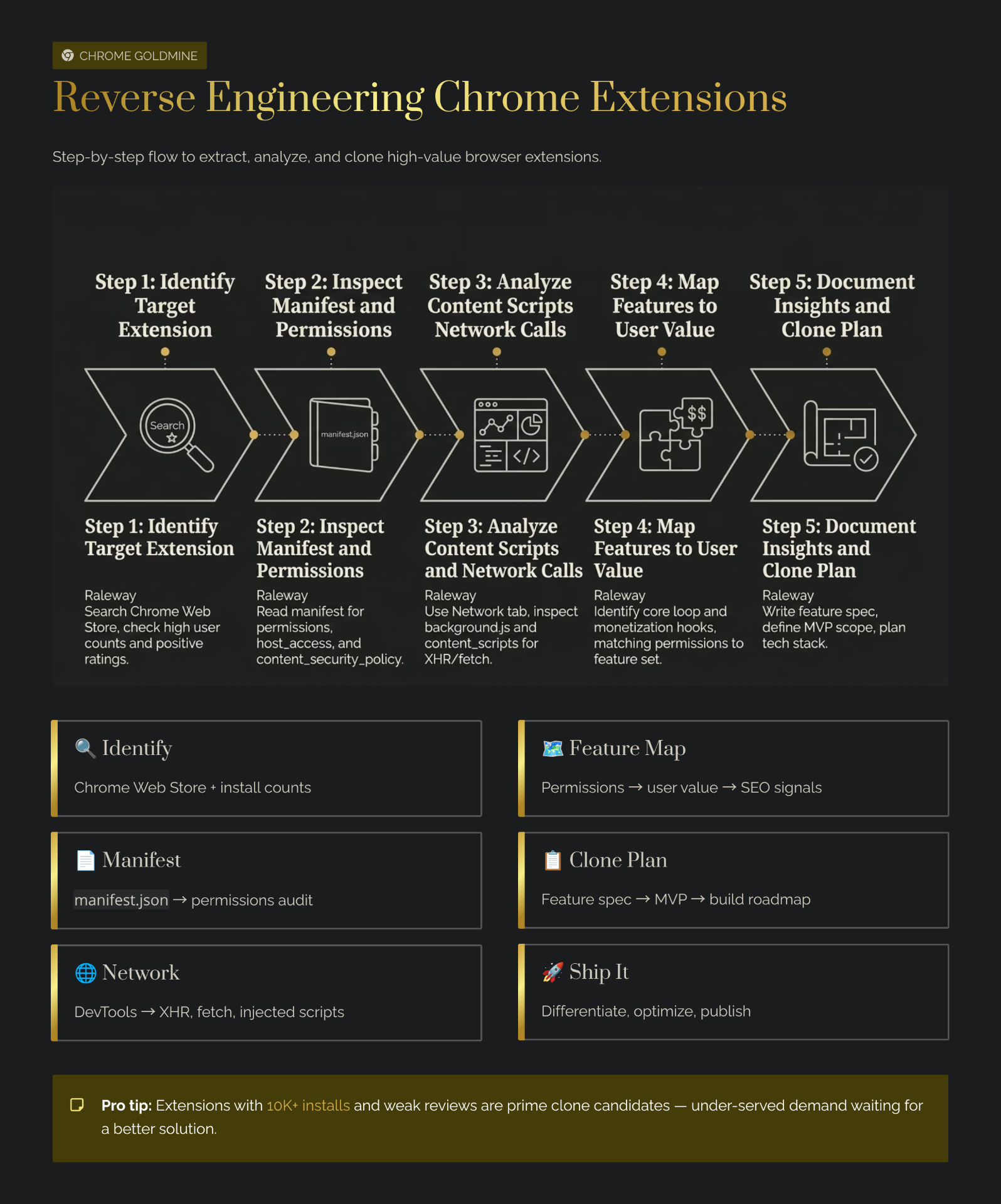
How do you reverse engineer profitable Chrome extensions so you can copy what works — without cloning them? The answer lies in a systematic framework that moves beyond surface-level observation. Instead of merely replicating features, you deconstruct their underlying business model, user experience, and marketing strategies. This allows you to identify successful patterns and translate those insights into unique, differentiated ideas for your own extensions.
This article provides a repeatable teardown framework to study successful Chrome extensions. You'll learn to understand their core mechanics, monetization strategies, and user engagement tactics. By applying this ethical approach, you can learn from the best, avoid common pitfalls, and generate innovative ideas that resonate with users and drive revenue. For a broader overview of where to start, see the How to Build Chrome Extensions pillar.
Why Reverse Engineering Chrome Extensions Works (When Done Ethically)
Studying existing winners is a powerful shortcut to success. The Chrome Web Store, with approximately 138,000 extensions as of 2024 (DebugBear), is a vast laboratory of product experiments. By analyzing successful extensions, you gain insights into:
- Validated Demand: Top extensions have already proven that a significant user base exists for their solution.
- Proven Monetization: You can observe effective pricing strategies and business models that generate revenue.
- Clear UX Patterns: Successful extensions often share common user experience patterns that lead to high engagement and satisfaction.
It's crucial to emphasize ethics in this process. Reverse engineering is about learning from patterns, not copying. Never copy branding, assets, or proprietary code. Focus on understanding the *why* behind their success. While 86.3% of extensions have fewer than 1,000 users, the top 0.2% (around 242 extensions) boast over 1 million users — demonstrating immense potential when a product truly hits the mark. Your goal is to understand what makes these top performers successful and apply those principles to your original ideas.
Step 1 – Pick the Right Extensions to Analyze
Choosing the right candidates for analysis is critical. Not all popular extensions offer valuable insights for your specific goals. Focus on extensions that demonstrate clear signs of success and relevance.
Criteria for Choosing Candidates
- Healthy User Count: Look for extensions with 10,000+ users. This indicates validated demand for their core functionality.
- Solid Ratings: Extensions with 4.0+ star ratings and good review volume suggest user satisfaction and a well-executed product.
- Clear Monetization: Can you easily identify how the extension makes money? Look for visible pricing pages, subscription options, or in-app purchases.
Mega-Players vs. Mid-Market Indie Successes
There's a key difference between studying mega-players (e.g., Grammarly-type tools with massive funding) and mid-market indie successes. While mega-players offer insights into broad market trends, indie successes often provide more actionable lessons for solo founders or small teams. They typically operate with leaner resources and more direct monetization strategies.
How Chrome Goldmine Helps
The Chrome Goldmine database is invaluable for finding the right analysis targets. It helps you find high-signal examples — extensions that once had significant user bases but are now inactive, indicating past demand that might still exist. You can also spot underserved niches by analyzing what worked and what didn't.
Good Targets: Niche productivity tools, specialized developer utilities, content curation extensions with clear value propositions. Bad Targets: Generic ad blockers, extensions relying on scraping sensitive data, or those with unclear monetization.
Step 2 – Break Down Their Business Model and Metrics
Once you've selected an extension, dissect its business model. This goes beyond features — it's about understanding how the extension creates and captures value.
Case Study: GMass ($130k/month)
Let's take GMass as an example — one of the most profitable Chrome extensions ever built:
- Pricing Strategy: Tiered subscription model starting at $19.95/month, focusing on recurring revenue.
- Feature Tiers: Different tiers offer varying functionality (more emails, advanced reporting), catering to different user segments and enabling upsells.
- Target Audience: Email marketers, sales professionals, and anyone needing bulk email within Gmail.
- Revenue: $130,000/month with 1M+ users — demonstrating willingness to pay for workflow-critical tools.
Key Business Questions to Ask
- What problem is this solving? (e.g., GMass solves mass personalized email from Gmail)
- Who is willing to pay for this solution? (e.g., professionals who rely on email for business)
- Why this price range? (e.g., time saved and improved outreach justifies the subscription cost)
- What's the competitive landscape? Cross-reference with the Chrome Goldmine database to see alternatives and gaps.
Successful extensions averaging $862k/year with 70-85% profit margins demonstrate that users willingly pay for solutions that significantly enhance their workflow. For a deeper dive into monetization models, see our monetization guide. To turn your analysis into a revenue plan, see our $1,000/month side income blueprint for portfolio math and pricing strategies.
Step 3 – Analyze UX, Onboarding, and Retention Hooks
The user experience and how an extension guides new users are critical for adoption and retention. Analyzing these aspects provides insights into what makes an extension sticky.
Real Examples to Study
- Momentum Dash (momentumdash.com/plus): 3M+ users, freemium at $3.33/mo billed annually. Smooth onboarding with a beautiful dashboard immediately upon installation, minimal permissions, and a quick tour. Daily new quotes and focus features act as subtle retention hooks.
- MaxAI: 800,000 users, AI-powered productivity using a subtle sidebar or context menu integration to provide AI assistance without disrupting flow.
- Weather Extension: 200,000+ users, freemium at $9.99 premium, generating $2,500/month — proving even simple utility extensions can monetize well.
UX Evaluation Checklist
- Is the first-run experience clear and concise? (Minimal steps, clear value proposition)
- Does the UI feel native to Chrome and the web? (Avoid clunky, non-standard elements)
- Are key features easily discoverable? (No hidden menus or complex workflows)
- Does it integrate with existing workflows? (Context menus, keyboard shortcuts, data sync)
- Does it provide value without being intrusive? (Balance functionality with performance)
Effective UX directly contributes to higher ratings, better reviews, and less churn. For more on what makes extension UX work (and fail), see our productivity extension shutdowns analysis.
Tools for Reverse Engineering Extensions
You don't need expensive tools to reverse engineer extensions. Here are the best free and low-cost options:
| Tool | What It Does | Best For |
|---|---|---|
| Browser DevTools | Network tab (API calls), Application tab (storage/cookies), Sources tab (JS debugging) | Understanding data flow and APIs |
| Chrome Extension Downloader | Download CRX files for static analysis of manifest, permissions, and scripts | Inspecting extension structure |
| ExtAnalysis | Static analysis platform for manifest, scripts, and permissions | Security and code inspection |
| ChromeStats | Historical data on installs, users, and update frequency | Tracking growth patterns |
| Mangools | Affordable SEO suite for keyword research, SERP analysis, and competitor tracking | Understanding marketing channels and search demand |
Step 4 – Turn Insights into Your Own Extension Ideas
This is where the magic happens: transforming analytical insights into original, differentiated extension ideas. The goal is not to clone, but to innovate based on proven patterns.
Steps to Generate Original Ideas
- Extract Patterns: Identify recurring successful patterns. For example: "B2B + automation + recurring billing" from extensions like GMass.
- Apply to New Niches: Take that pattern and apply it to an underserved niche. If GMass automates email for sales, could you create an extension that automates a similar process for legal professionals, HR, or logistics?
- Simplify or Specialize: Can you take a broad solution and make it hyper-focused for a specific problem? Or improve the UX significantly?
Use the Chrome Goldmine database to find expired extensions with similar patterns and validate demand in different categories. Cross-reference successful patterns with categories to identify new opportunities. For more on finding ideas, see our idea discovery guide. Track all your analysis targets in a structured Deal Flow CRM in Notion to compare and prioritize ideas. To understand the broader market your target extensions operate in, consult our expired extensions market analysis for 2026.
Mini-Example: From Momentum to a New Idea
We studied Momentum Dash and observed its pattern of "personalization + productivity + recurring subscription." We then designed a new idea: an extension that provides personalized, AI-generated writing prompts and focus music for writers — targeting a different niche with a proven monetization model. This is the power of pattern extraction over cloning.
What Doesn't Work: Copy‑Paste Clones and Shallow Analysis
While reverse engineering is powerful, it comes with significant pitfalls if approached incorrectly. Many aspiring developers fall into the trap of creating copy-paste clones or conducting shallow teardowns, which almost always lead to failure.
Failure Patterns to Avoid
- Blind Clones: Replicating an existing extension's UI, messaging, and niche without adding unique value. You'll compete directly with established brands on their turf with inferior resources.
- Shallow Teardowns: Only looking at surface-level UI without understanding the underlying business context, monetization strategy, or user psychology.
- Legal and Ethical Issues: Copying code, branding, or scraping user data can lead to trademark infringement, copyright violations, and Chrome Web Store policy breaches (Chrome Developer Policies).
If you only copy surface-level details, you'll compete with stronger brands on their turf, offering no compelling reason for users to switch. True success comes from understanding the underlying principles and applying them creatively.
Is Reverse Engineering Worth Your Time? (ROI Overview)
Investing time in reverse engineering is a high-leverage activity that can save you months of wasted effort. Here's what you can expect:
| Time Investment | Cost | Expected Outcome |
|---|---|---|
| 3–5 hours | $0–$20 | 2–3 analyzed extensions, basic pattern notes |
| 6–10 hours | $0–$40 | Clear pattern library + 3–5 new idea drafts (using Chrome Goldmine for target selection) |
| 10–20 hours | $0–$60 | 1–2 well-scoped extension specs ready for development |
This investment lets you avoid months of building ideas that never had demand and build a personal library of "what works" that you can reuse for future projects. Ready to accelerate? Our weekend challenge guide shows how to go from idea to first dollar in 48 hours. And if your analysis uncovers a promising expired extension, follow our 7-day revival playbook to bring it back as a modern micro-SaaS.
Your Framework for Innovation
Reverse engineering Chrome extensions is not about copying — it's about strategic learning and ethical innovation. By systematically deconstructing the success of others, you gain an unparalleled understanding of market demand, effective monetization, and compelling user experiences.
This framework empowers you to move beyond guesswork, transforming observed patterns into original, profitable ideas. Start applying this framework today, and turn competitive analysis into your blueprint for building the next hyper-profitable Chrome extension. Use the Chrome Goldmine database to find your first analysis targets and kick-start your idea pipeline.